
What's on this page
- What negligence means in plain terms
- What malpractice means in plain terms
- Malpractice is negligence with a professional label
- The core difference: whose standard applies
- The four elements, side by side
- Duty: an ordinary person versus a professional peer
- Breach: common sense versus an expert-established standard
- Causation and damages: more alike than people expect
- Example one: an ordinary negligence claim
- Example two: a premises negligence claim
- Example three: a nursing malpractice claim
- Why the nursing example generalizes to other licensed professions
- Why malpractice needs a paid expert and ordinary negligence usually does not
- What the cost of proof actually buys
- Filing deadlines and procedural requirements differ
- Who can be sued differs
- Comparative fault applies to both, the same way
- Where the line blurs: gross negligence and recklessness
- Informed consent: a theory unique to the professional-duty world
- A worked comparison: two claims, one fault share
- Common misconceptions about malpractice vs negligence
- What this means for your own claim
- When to consult a licensed attorney
- The bottom line
Short answer: Malpractice is negligence committed by a licensed professional, measured against a professional standard of care instead of ordinary caution. Both share the same four elements, duty, breach, causation and damages, but malpractice almost always needs a paid expert to establish the standard, carries stricter deadlines, and costs far more to prove. Nursing is one example of professional negligence among many, not a separate category. Consult a licensed attorney in your state before relying on any of this for your own claim.
Malpractice vs negligence is a question people usually ask backwards. They assume malpractice is a different kind of wrongdoing entirely, something closer to intentional harm, when in fact it is the same legal idea, carelessness that caused injury, applied to a person whose job comes with a professional standard the rest of us are not held to. A delivery driver who runs a stop sign and a surgeon who skips a required check before an operation are both answering the identical legal question: did your conduct fall below the standard that applied to you, and did that shortfall cause the harm. What changes is whose judgment sets the standard, who is qualified to say it was missed, and what it costs to prove.
This explainer sorts out where malpractice and negligence actually part ways and where they are functionally identical, using three contrasting examples, an ordinary car accident, a premises slip and fall, and a nursing malpractice scenario, so the nursing angle sits alongside other professions rather than standing in for the whole subject. For the mechanics of a malpractice claim specifically, see our medical malpractice explainer; for how a fault percentage reduces a recovery, see our comparative negligence explainer. Every figure below is illustrative, none of it is legal advice, and the rules discussed vary by state.
Key takeaways
- Malpractice is not a separate tort from negligence. It is negligence committed by a licensed professional, measured against the standard a reasonably careful member of that profession would have met, rather than against ordinary caution.
- Both share the same four elements, duty, breach, causation and damages. The difference is whose standard applies and who is qualified to say it was breached, not the underlying legal structure.
- Malpractice claims almost always need a paid expert to establish the professional standard before anyone knows if a claim is viable. Most ordinary negligence claims do not carry that cost.
- Comparative fault reduces a recovery by the same mechanics in both settings. What differs is the content of the fault argument, not the math behind it.
- Nursing malpractice is one example of professional negligence among many licensed professions. Figures here are illustrative; speak with a licensed attorney in your state about your own facts.
What negligence means in plain terms
Negligence is the legal idea that a person who owed a duty of reasonable care to someone else, breached that duty through carelessness, and caused injury as a result, owes compensation for the harm. The standard is the conduct of a reasonably careful person in the same situation: not perfection, and not the most cautious choice imaginable, but what an ordinarily sensible person would have done. A jury does not need any special training to apply it, because the standard is built from shared, everyday experience, stopping at a red light, mopping up a spill, keeping a hallway clear.
That everyday quality is what makes most negligence claims comparatively fast to evaluate. The facts are usually the real argument: who did what, when, and how badly, rather than what the applicable standard even was. Our explainers on what to do after a car accident and premises liability describe this everyday-standard world in more detail, including how a duty arises and what breaks it.
What malpractice means in plain terms
Malpractice is negligence committed by someone practicing a licensed profession, acting in that professional capacity, measured against the standard that a reasonably careful member of that profession would have met in the same circumstances. The term applies most often to physicians and nurses, but it covers other licensed professions too, including attorneys, accountants, architects and engineers, wherever professional judgment rather than everyday common sense sets the bar for conduct.
The structure is identical to ordinary negligence: duty, breach, causation, damages. What is different is the content of the breach question. Instead of asking whether a reasonably careful person would have acted differently, the question becomes whether a reasonably careful professional in that specific field, given that training and those circumstances, would have acted differently. That is usually not something a jury can answer from its own experience, which is the seed of nearly every practical difference discussed below.
Malpractice is negligence with a professional label
It helps to say this plainly because so much confusion starts here: malpractice is not a separate tort sitting apart from negligence law, with its own elements and its own logic. It is negligence law, applied to a defendant whose conduct is judged by a professional rather than an everyday standard. Courts and legal treatises describe malpractice as professional negligence for exactly this reason.
That relationship matters practically. A plaintiff’s attorney building a malpractice case is not inventing a new kind of argument; they are proving the same four elements any negligence claim requires, with the breach element requiring professional testimony instead of common experience. Understanding malpractice as negligence with an added evidentiary requirement, rather than as a wholly separate legal animal, is the single idea that makes the rest of this comparison make sense.
The core difference: whose standard applies
Strip away the procedural differences and one question decides whether a case is ordinary negligence or malpractice: does evaluating the alleged failure require specialized professional judgment, or can a layperson evaluate it using common experience. If a reasonable person off the street could look at the conduct and say whether it was careless, it is ordinary negligence. If evaluating it requires knowing what a reasonably careful member of a licensed profession would have done in that specific clinical, legal, financial or technical situation, it is malpractice.
Run your own numbers in the estimator below to see how your documented damages, your fault share and your claim type interact; jump to it any time at the calculator.
This single test resolves most of the edge cases people get stuck on. A nurse who misjudges a deteriorating patient’s vital signs is being judged on nursing knowledge: malpractice. The same nurse who leaves a supply cart blocking a stairwell, causing a visitor to fall, is being judged on the same common sense that applies to anyone: ordinary negligence. The professional’s job title does not control the category. What they were doing, and what kind of judgment that required, does.

The four elements, side by side
Every negligence claim, ordinary or professional, rests on the same four building blocks, and seeing them side by side is the fastest way to understand what actually changes between the two.
- Duty: in ordinary negligence, the duty owed to others generally, for instance a driver’s duty to operate a vehicle safely. In malpractice, the duty a licensed professional owes within the professional relationship, for instance a nurse’s duty to a patient under her care.
- Breach: in ordinary negligence, falling short of what a reasonably careful person would have done, judged from common experience. In malpractice, falling short of what a reasonably careful member of that profession would have done, usually established by a qualified expert.
- Causation: in both, a showing that the breach, not some other cause, actually produced the harm. This element is often harder in malpractice, because an underlying illness or condition can produce a similar-looking outcome even with appropriate care.
- Damages: in both, the actual harm suffered, economic and non-economic. The categories are similar; what differs is often the scale and complexity of proving them in a professional-negligence setting.
The elements do not change. What changes is who can credibly testify about the second one, and that single fact ripples through cost, timeline and deadlines, covered below.
Duty: an ordinary person versus a professional peer
A duty of reasonable care exists almost everywhere: drivers owe it to other road users, property owners owe it to visitors, manufacturers owe it to the people who use their products. In ordinary negligence, the content of that duty is set by general expectations about reasonable behavior, expectations most adults share without needing it explained.
A professional duty is narrower in who owes it and more specific in what it requires. It arises from a defined relationship, a clinician-patient relationship, an attorney-client relationship, and its content is set by the norms of that profession rather than by general reasonableness. A reasonably careful driver and a reasonably careful nurse are both real standards, but only one of them can be stated accurately by someone off the street. That asymmetry is the whole reason the rest of malpractice procedure looks different from ordinary negligence procedure.
Breach: common sense versus an expert-established standard
Breach is where the practical gap between the two categories is widest. In an ordinary negligence claim, a jury hears the facts and decides, using its own judgment, whether the defendant acted as a reasonably careful person would have. No outside witness has to explain what reasonable driving looks like; everyone on the jury already knows.
In a malpractice claim, courts in most states will not let a jury reach that conclusion on its own, on the view that professional conduct is specialized knowledge outside ordinary experience. A qualified expert, typically another practitioner in the same field, has to review the record and testify to what the accepted standard was, whether the defendant’s conduct departed from it, and whether that departure caused the harm. Without that testimony, a malpractice claim in most states cannot proceed past an early stage, regardless of how bad the outcome looks.
Causation and damages: more alike than people expect
Causation and damages are where malpractice and ordinary negligence look most similar, which surprises people who assume the entire claim is different. In both settings, the plaintiff has to show that the defendant’s specific failure, not some unrelated cause, produced the harm, and has to quantify what that harm actually cost in economic and non-economic terms.
The complication in malpractice is that the person was often already sick, injured or at risk before the professional’s involvement, so the defense frequently argues that the underlying condition, not the alleged failure, explains the outcome. An ordinary negligence case rarely carries that complication: a driver who was not hit by anyone before the collision has a cleaner causal story to tell. Damages categories, medical costs, lost income, pain and suffering, are structurally the same in both, though a serious malpractice injury often produces a larger and more complex damages picture, discussed further below.
Example one: an ordinary negligence claim
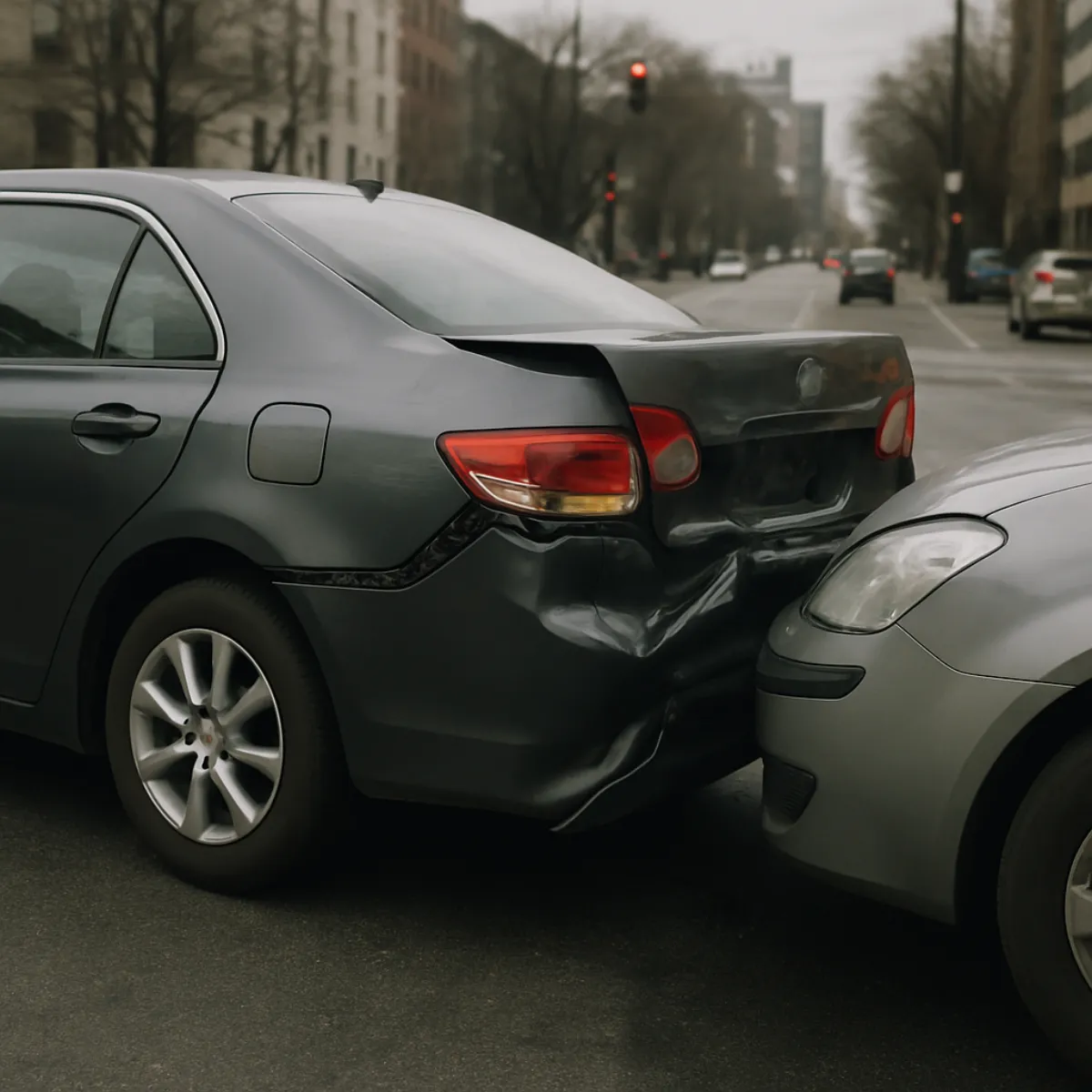
Picture a straightforward rear-end collision. One driver, stopped at a red light, is struck from behind by a driver who was following too closely and looking at a phone. The injured driver documents six thousand dollars in medical bills and two thousand dollars in lost wages, an illustrative eight thousand dollars in economic damages.
Evaluating this claim requires no specialized expert. The police report, the dashcam footage if any exists, and the simple fact pattern, stopped car, struck from behind, tell a jury everything it needs to judge whether the at-fault driver was reasonably careful. The cost of proving breach here is close to the cost of gathering the report and photographs, a few hundred dollars at most. Our car accident claim explainer covers documenting a claim like this one from the scene onward.
Example two: a premises negligence claim
Now picture a grocery store customer who slips on a spill that had been on the floor, unmarked, for twenty-five minutes before the fall, established by the store’s own inspection log. This is still ordinary negligence: the duty is a property owner’s duty to maintain a reasonably safe space, and the breach, failing to find and address a hazard for twenty-five minutes, is something any reasonable person can evaluate once the timeline is established.

The evidence here, an inspection log, photographs, maintenance records, is more involved than a simple collision but still something a store manager, an adjuster and a jury can evaluate without hiring a specialist to explain what reasonable floor maintenance looks like. Our slip and fall explainer covers how notice, meaning how long a hazard existed uncorrected, usually decides these claims.
Example three: a nursing malpractice claim
Now contrast both with an illustrative nursing malpractice scenario. A hospitalized patient’s vital signs begin trending toward a recognized pattern of deterioration over several hours. The assigned nurse documents the readings but does not escalate them to the attending physician within the window nursing protocols in that setting generally call for, and the patient’s condition worsens before anyone intervenes.
Whether that delay fell below the standard of care is not something a juror can answer from ordinary experience. It requires a nursing expert to explain what a reasonably careful nurse, with the same training, working the same shift, seeing the same readings, should have recognized and when escalation should have occurred. That single requirement, a paid expert who has to review the chart and form an opinion before anyone knows whether the claim is viable, is the structural feature that separates this scenario from both examples above, not the fact that a hospital was involved.
Why the nursing example generalizes to other licensed professions
Nursing malpractice is a useful illustration precisely because it is common, well documented in legal literature, and easy to picture, but the same structure applies well beyond nursing. An attorney who misses a filing deadline, an accountant who miscalculates a tax position relying on settled guidance, an architect who specifies a structural element outside code, an engineer who signs off on a calculation a reasonably careful peer would have caught, are all professional-negligence claims with the identical shape: a licensed person’s professional judgment is the thing being measured, and a peer in that profession is the one qualified to say it fell short.
What ties nursing, medicine, law, accounting and engineering together as malpractice fields is not the subject matter. It is that each profession has its own internal standard that outsiders cannot credibly evaluate without specialized testimony. If your situation involves a licensed professional whose judgment, not their ordinary conduct, is in question, the malpractice framework in this explainer likely applies regardless of which profession it is.
Why malpractice needs a paid expert and ordinary negligence usually does not
The expert requirement is not a technicality tacked onto malpractice claims; it follows directly from the breach standard discussed above. If a jury cannot evaluate whether professional conduct was reasonable using its own experience, someone qualified has to supply that judgment, and that person has to be paid for the time spent reviewing records, forming an opinion and testifying.
Ordinary negligence claims occasionally use experts too, for accident reconstruction in a complex crash or for a disputed damages calculation, but it is the exception rather than the rule. Malpractice claims use one as a near-universal prerequisite. Many states formalize this further with a pre-suit screening or certification requirement, often needing a qualifying expert affidavit before a malpractice case can even be filed, a step ordinary negligence claims do not carry. This is the single biggest reason malpractice claims cost more to develop and why attorneys screen them harder before accepting one.
What the cost of proof actually buys
It helps to see the cost of proof as something concrete rather than an abstraction. In an illustrative ordinary negligence claim like the rear-end collision above, establishing breach costs close to nothing beyond obtaining the police report and photographs, perhaps five hundred dollars of time and copying fees. In an illustrative premises claim like the slip and fall, establishing notice through an inspection log and timeline might run eight hundred dollars. In an illustrative malpractice claim, a single qualified expert’s record review and opinion commonly runs into five figures, illustratively fifteen thousand dollars, before anyone knows whether the opinion will even support the claim.
Illustrative cost of proof to establish breach, by claim type
What it typically takes to show the standard was missed, on one shared scale. Illustrative figures only, never a quote for any real claim.
Bar widths are each illustrative cost as a share of the largest ($15,000 for a malpractice expert review). The contrast is the point: an ordinary negligence claim is proved largely from documents that already exist, while a malpractice claim has to purchase its proof from a qualified professional before anyone knows what the claim is worth. These figures are illustrative and vary enormously by specialty, record volume and jurisdiction.
This is also why firms that handle both kinds of claims screen malpractice matters far more cautiously. An ordinary negligence claim with modest damages is still usually worth pursuing because the cost of proving it is low. A malpractice claim with the same modest damages may not clear its own cost of proof, which is a business reality of the claim, not a judgment about whether something went wrong.
Filing deadlines and procedural requirements differ
Filing deadlines diverge sharply between the two categories, and this is one of the few places a general explainer can speak with real confidence about the shape of the difference, even without giving you a specific date. Ordinary negligence claims typically run on a single limitations period measured from the date of the incident, a deadline that is comparatively predictable and the same regardless of who the defendant is.
Malpractice deadlines are shorter in practice more often than not, frequently use a discovery-based start date, meaning the clock can begin when the harm was or reasonably should have been found rather than when the treatment happened, and are often paired with an outer cutoff that applies regardless of discovery. Many states also require a notice period or a certification step, sometimes including a qualifying expert affidavit, before a malpractice claim can be filed at all, adding real time to the front end of the process. Our filing-deadline explainer covers the general mechanism without pretending to give you a date; confirm your actual deadline with a licensed attorney in your state.
Who can be sued differs
In an ordinary negligence claim, the defendant list is usually short and obvious: the driver, the property owner, the company whose employee caused the harm. Vicarious liability, an employer answering for an employee’s negligence, applies straightforwardly in most cases.
In a malpractice claim, the defendant list is often longer and less obvious than it first appears, because care is frequently delivered by a team working across one or more organizations, and whether a hospital answers for a given clinician’s conduct can turn on whether that clinician was an employee or an independently contracted provider working within the hospital’s walls, a distinction patients rarely know about in advance. Our medical malpractice explainer covers why the employment relationship, not simply who was in the room, usually decides the defendant list in these claims.
Comparative fault applies to both, the same way
Most states apply a comparative-fault framework across the board: a percentage of fault assigned to the injured person reduces the recovery by that same percentage, and in some states a share at or above a set threshold, commonly discussed around fifty percent, bars recovery entirely. Mechanically, this applies identically whether the claim is an ordinary negligence matter or a malpractice matter.
What differs is the content of the fault argument, not its structure. In a car accident, the fault argument usually concerns the moments immediately before the collision: speed, signaling, right of way. In a malpractice claim, the fault argument more often concerns whether the patient disclosed relevant history, followed treatment instructions, attended follow-up appointments or reported worsening symptoms promptly, a dispute that frequently turns on records and testimony rather than on a single clear moment, and can be harder to resolve cleanly. Our comparative negligence explainer covers the full mechanics of how a fault percentage reduces a settlement.
Where the line blurs: gross negligence and recklessness
Gross negligence sits beside, not in place of, the negligence-versus-malpractice distinction, and it is worth separating the two ideas clearly. Gross negligence describes how far conduct departed from the applicable standard, an extreme departure bordering on reckless indifference rather than an honest, ordinary mistake. It can occur in either an ordinary negligence setting or a malpractice setting.
A drunk driver who causes a collision may be found grossly negligent, which is still ordinary negligence law, just at the severe end of the spectrum. A clinician who proceeds with a procedure despite an unmistakable, documented contraindication might likewise be found grossly negligent, which is still malpractice law. Some states treat a finding of gross negligence differently for purposes of damages caps or other procedural rules, and those rules vary considerably, so this distinction is worth raising with a licensed attorney if the facts of your situation feel closer to recklessness than to an honest oversight.
Informed consent: a theory unique to the professional-duty world
Informed consent is a theory that exists almost exclusively on the malpractice side of this comparison, and it is worth naming because it does not map onto anything in ordinary negligence. The claim is not that the professional performed a task incompetently; it is that the patient was not given the information a reasonable person would have needed to decide whether to proceed at all, the material risks, the realistic alternatives, and what happens if nothing is done.
Because it is a separate theory from a claim about technique, a procedure can be performed competently and still support an informed consent claim, and the reverse can also be true. A signed form documents that a conversation happened; it does not by itself prove the conversation was adequate. There is no equivalent concept in an ordinary negligence claim like a car accident, because ordinary negligence does not involve a professional obtaining a patient’s or client’s agreement to proceed with a course of action in the first place.
A worked comparison: two claims, one fault share
Take two illustrative claimants with identical documented economic damages and an identical fault dispute, so the only variable left is the claim type. Both have six thousand dollars in medical bills and two thousand dollars in lost wages, eight thousand dollars in documented economic damages. In both, the defense argues the claimant bears ten percent of the fault, for failing to signal in the collision case and for missing a follow-up appointment in the malpractice case.
Applying the ten percent fault share to both claimants’ eight thousand dollars in economic damages reduces each to an identical seven thousand two hundred dollars, kept. The fault mechanics do not care which kind of claim it is. What diverges from here is the cost of proof: the ordinary negligence claimant spends roughly five hundred dollars proving breach and moves toward resolution. The malpractice claimant needs an illustrative fifteen thousand dollars in paid expert review before anyone can say the claim is viable at all, an outlay larger than the claimant’s own adjusted economic damages on these illustrative figures. That gap, not the fault math, is the entire practical difference between the two claims from here forward.
Where $8,000 in economic damages goes after a 10% fault share
Both claim types reduce identically on the same fault percentage. Illustrative only, never a prediction for any claim.
This split applies identically whether the claim is ordinary negligence or malpractice, because comparative-fault mechanics do not vary by claim type. What varies is everything upstream of this chart: what it costs to prove the claim exists in the first place. Run your own documented figures through the fault-and-cost estimator to see how your numbers move.
Common misconceptions about malpractice vs negligence
A handful of beliefs come up often enough to name directly. The first is that malpractice is somehow more serious or more blameworthy than negligence by definition. It is not; a minor documentation lapse can be malpractice and a catastrophic multi-vehicle pileup can be ordinary negligence. Seriousness is about the harm and the departure from the standard, not about which category the claim falls into.
The second misconception is that any claim involving a doctor, nurse or other licensed professional is automatically malpractice. It is not: a visitor who trips over a cord in a hospital hallway has an ordinary premises negligence claim against the hospital, not a malpractice claim, because evaluating a loose cord requires no clinical judgment. The third is that malpractice claims always involve larger payouts. Cost of proof, litigation risk and procedural hurdles can make a malpractice claim less attractive to pursue than a comparably sized ordinary negligence claim, not more. The fourth is that negligence is somehow the lesser or lighter legal theory. It is the parent category; malpractice lives inside it.
What this means for your own claim
If you are trying to work out which category your own situation fits, the test from earlier in this explainer is the practical starting point: did evaluating the alleged failure require specialized professional judgment that only a peer in that field could credibly assess, or could a reasonable person evaluate it using common experience. That answer, more than who the defendant is or how serious the harm feels, determines which path your claim follows, what it will cost to develop, and what deadline governs it.
It is also worth checking whether your situation is genuinely one category or actually touches both. A hospital visit can produce an ordinary premises claim, a slip on a wet floor, alongside an entirely separate clinical malpractice question, a missed diagnosis during the same stay, and the two would be evaluated, proved and potentially filed on different timelines even though they arose from the same visit. Sorting that out accurately is exactly the kind of judgment call worth bringing to an attorney early rather than assuming either category by default.
When to consult a licensed attorney
Because malpractice claims carry a paid-expert prerequisite, stricter deadlines and often a mandatory pre-suit step, getting a licensed attorney’s assessment early matters more here than in most ordinary negligence claims, where many people reasonably handle smaller, clearly liable matters themselves. Most personal-injury attorneys who handle malpractice work on contingency and offer an initial consultation at no cost, so getting that assessment typically costs you nothing but time, and it is the fastest way to find out whether your situation is a viable malpractice claim, an ordinary negligence claim against a different defendant, or some mix of both.

Bring what you have: a written timeline, the names of everyone involved, any records already in your possession, and your own notes of what you were told and when. Our how to find a personal injury lawyer explainer covers choosing counsel for either kind of claim, and our personal injury claim worth explainer covers how value is estimated once liability is established.
The bottom line
Malpractice vs negligence is not a contest between two unrelated legal theories; it is the same negligence framework, duty, breach, causation, damages, applied to a defendant whose conduct is measured against a professional standard rather than an everyday one. Nursing malpractice, medical malpractice generally, legal malpractice and other professional-negligence claims all share that same structural feature: a peer in the profession, not a juror’s common sense, has to say what the standard was and whether it was met.
That one requirement is why malpractice claims cost more to prove, move more slowly, and carry stricter, more technical deadlines than an ordinary negligence claim like a car accident or a slip and fall, even though the comparative-fault math that follows works identically in both. If your situation involves a licensed professional’s judgment rather than their ordinary conduct, treat it as a malpractice question from the start: gather your records, write down your timeline while it is fresh, and speak with a licensed attorney in your state promptly, since the deadline clock in this category is often shorter than it looks.
A closing word in our own voice: this explainer sorts out where malpractice and ordinary negligence overlap and where they diverge, using nursing as one illustration among several so the broader legal distinction stays the focus. It is not legal advice, it creates no attorney-client relationship, and it cannot account for the standard-of-care rules, deadline structures, notice requirements and damages rules that differ from state to state and change over time. Every dollar figure above is invented to show proportion, framed as a range and never a promise, and none of it predicts what any real claim will produce. If your own situation involves a licensed professional’s judgment, or you are unsure which category it falls into, the sound move is to put your specific facts in front of a licensed attorney in your state.
Frequently asked questions
What is the difference between malpractice and negligence?
Malpractice is negligence committed by a licensed professional acting within their profession, measured against the standard a reasonably careful member of that profession would have met, usually established by a qualified expert. Ordinary negligence is measured against what a reasonably careful person would have done in the same everyday situation, a standard a jury can apply from common experience without hiring anyone to explain it. Both share the same four legal elements: duty, breach, causation and damages. What changes is whose judgment sets the standard and how expensive it is to prove that the standard was missed. Malpractice is a subset of negligence, not a separate legal category standing apart from it.
Is medical malpractice a type of negligence?
Yes. Medical malpractice is professional negligence applied to clinicians and healthcare organizations: the same duty-breach-causation-damages structure as any negligence claim, with the breach measured against the accepted standard of care in that medical specialty rather than against ordinary caution. The practical differences, needing a qualified expert to state the standard, facing stricter and more technical filing deadlines, and often needing a pre-suit screening step, flow from that one structural fact rather than from malpractice being a wholly different kind of claim. An attorney evaluating a potential malpractice matter is still asking the same four negligence questions; the answers just require professional evidence.
What is the difference between malpractice and negligence in nursing?
Nursing malpractice is a nurse's professional negligence, measured against what a reasonably careful nurse with similar training would have done in the same clinical situation, often requiring a nursing expert to establish what that standard was and whether it was met. Ordinary negligence involving a nurse would be conduct outside that professional judgment entirely, for instance a nurse who causes a slip-and-fall hazard by leaving a cart blocking a hallway, which a jury can evaluate without any nursing expertise at all. The dividing line is whether the alleged failure required professional clinical judgment to commit, not simply whether a nurse happened to be involved.
Do I need an expert witness for a malpractice claim but not for an ordinary negligence claim?
In most states, yes, essentially every serious malpractice claim needs a qualified expert to state what the professional standard was, whether the care departed from it and whether that departure caused the harm, because the standard itself is specialized knowledge outside everyday experience. An ordinary negligence claim, a driver running a red light or a store leaving a spill unattended, usually rests on evidence a jury can evaluate directly: a police report, photographs, a witness account. Some negligence claims do use experts, for accident reconstruction or complex damages, but the professional-standard requirement that malpractice almost always carries is the structural difference.
Does comparative fault apply to malpractice claims the same way it applies to car accidents?
Mechanically, yes. Most states apply the same comparative-fault framework across negligence and malpractice claims: a percentage of fault assigned to the injured person reduces the recovery by that percentage, and in some states a sufficiently large share bars recovery entirely. What differs is the argument's content, not its math. In a car accident the argument is usually about the moment of the collision. In malpractice it is more often about whether the patient followed instructions, attended follow-up appointments or disclosed relevant history, which can be a harder and more fact-specific dispute to resolve than a traffic question.
What is gross negligence, and how is it different from malpractice?
Gross negligence is an extreme departure from ordinary care, conduct closer to reckless indifference than to an honest mistake, and it exists as a concept in both ordinary negligence and professional-negligence settings. Malpractice describes who the defendant is and what standard applies, a licensed professional measured against professional practice, while gross negligence describes how bad the departure from a standard was, in either setting. A malpractice case can involve ordinary carelessness or, less commonly, conduct severe enough to be called gross negligence, and the distinction can matter because some states treat gross negligence differently for damages caps or other procedural rules that vary by state.
How do filing deadlines differ between malpractice and ordinary negligence claims?
Malpractice deadlines are typically shorter, more technical and less forgiving than deadlines for an ordinary negligence claim like a car accident. Many states apply a discovery-based start date, running the clock from when the harm was or should have been found rather than from the date of treatment, paired with an outer cutoff that can end the claim regardless of discovery. Some states require a pre-suit notice or a certification step before a malpractice claim can even be filed. Ordinary negligence claims generally run on a single, more predictable limitations period from the date of the incident. Exact periods vary by state, so confirm yours with a licensed attorney rather than relying on a general figure.
Can a nurse or other licensed professional be sued for ordinary negligence instead of malpractice?
Yes, when the alleged conduct did not require professional clinical judgment to commit. Courts generally look at whether the claim turns on a professional standard, meaning a malpractice claim, or on an everyday standard of care that any reasonable person would recognize, meaning ordinary negligence, regardless of the defendant's job title. A nurse who misreads a deteriorating patient's vital signs is a malpractice question, because recognizing that requires nursing judgment. A nurse who leaves a wet floor unmarked in a hallway is an ordinary negligence question, because any reasonably careful person would see the hazard. The underlying facts decide the category, not the defendant's profession alone.

Hamza Hai is the editor of TortWise. She holds an MBA and reviews the site's articles against our editorial standards, checking that every figure is labelled for what it is, that nothing is presented as verified fact without a source the reader can check, and that the writing stays useful to a non-specialist.