
What's on this page
- Before you start: what to keep in your car
- Step 1: Stop, ensure safety, and check for injuries
- Step 2: Move to safety and turn on your hazards
- Step 3: Call the police and get a report
- Step 4: Exchange information without admitting fault
- Step 5: Document the scene with photos, video, and witnesses
- Step 6: Seek medical attention even if you feel fine
- Step 7: Notify your insurer and start the claim
- Step 8: Know your next steps and when to talk to a lawyer
- The first hour after a crash, by priority
- Documenting the scene: what to capture
- A worked example: the first hour of a rear-end collision
- Common mistakes to avoid
- Troubleshooting: hit-and-runs, uninsured drivers, and late injuries
- What to do after a winter car accident
- Winter fault questions: ice, snow, and the reasonable-driver standard
- Holiday-season crashes: rental cars, out-of-state drivers, and impaired-driver suspicions
- Your after-a-crash checklist
- The bottom line
Short answer: After a car accident, follow eight steps: stop and check for injuries, move to safety, call the police, exchange information, document the scene with photos and witness numbers, get medical care, notify your insurer, then plan your next steps. Safety outranks the claim, and the most damaging thing you can say at the scene is an admission of fault, even a reflexive apology. For injuries or disputed fault, consult a licensed attorney in your state.
A car accident collapses your attention to a few square feet of asphalt and a handful of decisions you never rehearsed. Metal is bent, adrenaline is up, someone is already saying something you should not agree to, and the choices you make in the next few minutes quietly shape everything that follows. Most people improvise those minutes, and the improvisation is exactly where the response goes wrong, because both your safety and any later claim are built or damaged at the scene, long before an insurer is ever on the phone.
This explainer turns that improvisation into an order you can actually follow: eight steps that take you from the first second after impact to the point where you know your next move, in sequence, each with what to do and the caveat that comes with it. It also covers what to do after a winter car accident, when ice, darkness and holiday traffic change the safety order but not the steps. It focuses on the immediate response, so when the conversation later turns to filing and value you can pair it with our step-by-step explainer on filing a car accident claim and our car accident settlement explainer. The goal is simple: by the end, you will know each move to make and each common mistake to avoid, so you protect the people involved first and the claim second, in that order.
Key takeaways
- The response to a car accident is an eight-step sequence: stop and check for injuries, move to safety, call the police, exchange information, document the scene, get medical care, notify your insurer, then plan your next steps.
- Safety always outranks the claim: protect people first, and never risk a second collision to save a bumper or gather a photo.
- The single most damaging thing you can say at the scene is an admission of fault, even a reflexive apology, because fault directly reduces or bars recovery in many states.
- Most of the first hour is documentation you can never recreate later: photos, video, witness numbers, and the police report number do more than anything you can say afterward.
- The process varies by state and insurer, and none of this is legal advice: for injuries, disputed fault, or an uninsured driver, consult a licensed attorney in your state.
Before you start: what to keep in your car
The best time to prepare for a crash is before one happens, because the steps below go far smoother when the pieces are already in your glovebox rather than scattered across a stressful scene. This is not complicated preparation. A few minutes now removes half the friction of a bad day later.
- Your insurance card and registration, current and easy to reach. Your insurer’s name, policy number, and claims phone number should be legible, not expired under a stack of napkins.
- Your phone, charged, with the camera ready. It is your camera, your voice recorder, your flashlight, and your line to 911, so a dead battery is a real liability. A cheap car charger earns its place.
- A printed checklist and a pen, kept in the glovebox. Under stress, memory fails and a simple card that says stop, safety, police, exchange, document, medical, insurer keeps you on track when your mind is racing.
- A basic emergency kit: a small first-aid kit, a flashlight, and reflective triangles or flares to warn oncoming traffic. Warning other drivers can prevent the second crash that the first one sets up.
- An emergency contact noted somewhere accessible, in case you are unable to make calls yourself.
Difficulty here is low, and no special skill is required, only order and a little calm. The whole immediate response, from impact to notifying your insurer, commonly takes under an hour of active effort, though the claim itself then runs for weeks or months as any treatment and negotiation play out. Everything below assumes you are physically able to act; if you are not, your health comes first, and someone acting for you can follow the same steps. If injuries are serious, fault is disputed, or the other driver is uninsured, treat that as your signal to bring in a licensed attorney rather than going it alone.
Step 1: Stop, ensure safety, and check for injuries
Before anything else, stop your vehicle and stay at the scene, because leaving the scene of a crash you were involved in is a serious offense in every state, even for a minor collision. Take one breath to steady yourself, then make your first job the only thing that truly cannot wait: people. Check yourself for injuries first, because you cannot help anyone if you are hurt and unaware of it, then check your passengers, then the occupants of the other vehicle if it is safe to approach.
If anyone is injured, call 911 immediately and say clearly where you are and what happened. Do not attempt to move a seriously injured person unless they are in immediate danger where they are, because moving someone with a spinal or neck injury can make it worse; let trained responders handle it. If someone is unconscious, not breathing, or bleeding heavily, that is an emergency, and the paperwork can wait until they are cared for. Stay calm, keep the injured person still and reassured, and let the dispatcher guide you.
Even when no one seems hurt, treat that with humility. Adrenaline masks pain, and people routinely walk away from a crash feeling fine only to stiffen up hours later, which is why Step 6 exists. So call in an ambulance if there is any doubt, and do not let anyone talk you out of it.
Watch out: do not let concern for your car override concern for people, and do not stand in live traffic to inspect damage. A surprising share of crash injuries happen after the initial impact, to people who got out and stood in the road. If it is dark or you are on a highway shoulder, stay aware of oncoming traffic the entire time. The claim can survive a dented fender; it cannot undo a second collision. People first, metal second, always.

Step 2: Move to safety and turn on your hazards
Once you know whether anyone is hurt, deal with the next hazard: the vehicles themselves sitting in a place where they can be hit again. Turn on your hazard lights immediately, before you do anything else, because they are the fastest way to tell oncoming drivers that something is wrong ahead. In low light, rain, or on a fast road, that warning buys the seconds that prevent a chain-reaction crash.
Then judge whether to move the vehicles. If the cars are drivable and you are on a busy roadway, most guidance is to move them out of live traffic to the shoulder, a nearby lot, or a side street, because a fender bender in a travel lane invites a far worse second collision. If a vehicle is not drivable, or if anyone is seriously injured and moving the car could complicate the scene, leave it where it is, get yourself and others to a safe spot away from traffic, and wait for help. Reflective triangles or flares, if you carry them, extend your warning further back up the road.
Know your state, though. Some jurisdictions ask you to leave the vehicles in place until police arrive when there are injuries or significant damage, so if you can safely photograph the original positions first, do it before you move anything. A few wide shots of where the cars came to rest can settle a fault dispute later, and they take ten seconds.
Watch out: moving to safety is about people, not about tidying up evidence. Do not sweep debris, do not straighten a bumper, and do not move a vehicle just to clear the road for convenience if someone is hurt inside it. The instinct to minimize disruption can erase the very scene that proves what happened. Get people and cars out of harm’s way, mark the original positions with a quick photo if you safely can, and then stand somewhere a passing car cannot reach you.
Step 3: Call the police and get a report
With everyone safe and out of traffic, call the police, because for anything beyond the most trivial bump an official report is one of the most valuable things a claim can carry. In many states you are legally required to report a crash when there are injuries or when property damage exceeds a set dollar amount, and even where it is optional, the report creates a neutral record that outlasts everyone’s shifting memory of a stressful event. When you call, give your location clearly and say whether anyone is hurt so the dispatcher can send the right response.
When officers arrive, give a factual account of what happened and let them document it. Answer their questions honestly, but stick to what you observed rather than speculating about speeds, distances, or blame. Before you leave, get the responding officer’s name and badge number and, most importantly, the report or incident number, because that number is the backbone of your file and insurers routinely ask for it. Ask how and when you can obtain a copy of the full report.
If police decline to respond to a minor crash, which happens, ask how to file a report yourself, since many states let you submit one at a station or online within a short window. Do it promptly while the details are fresh.
Watch out: do not let the other driver talk you out of calling the police. A common line at the scene is to keep insurance out of it and settle in cash, and it almost always favors the person at fault. That handshake evaporates the moment a repair estimate comes in higher than expected or a sore neck appears the next morning, and without a report you are left reconstructing a scene that no longer exists. Reporting costs you a few minutes; skipping it can cost you the entire claim, especially in a disputed or hit-and-run case where the report is the only neutral proof you have.
Step 4: Exchange information without admitting fault
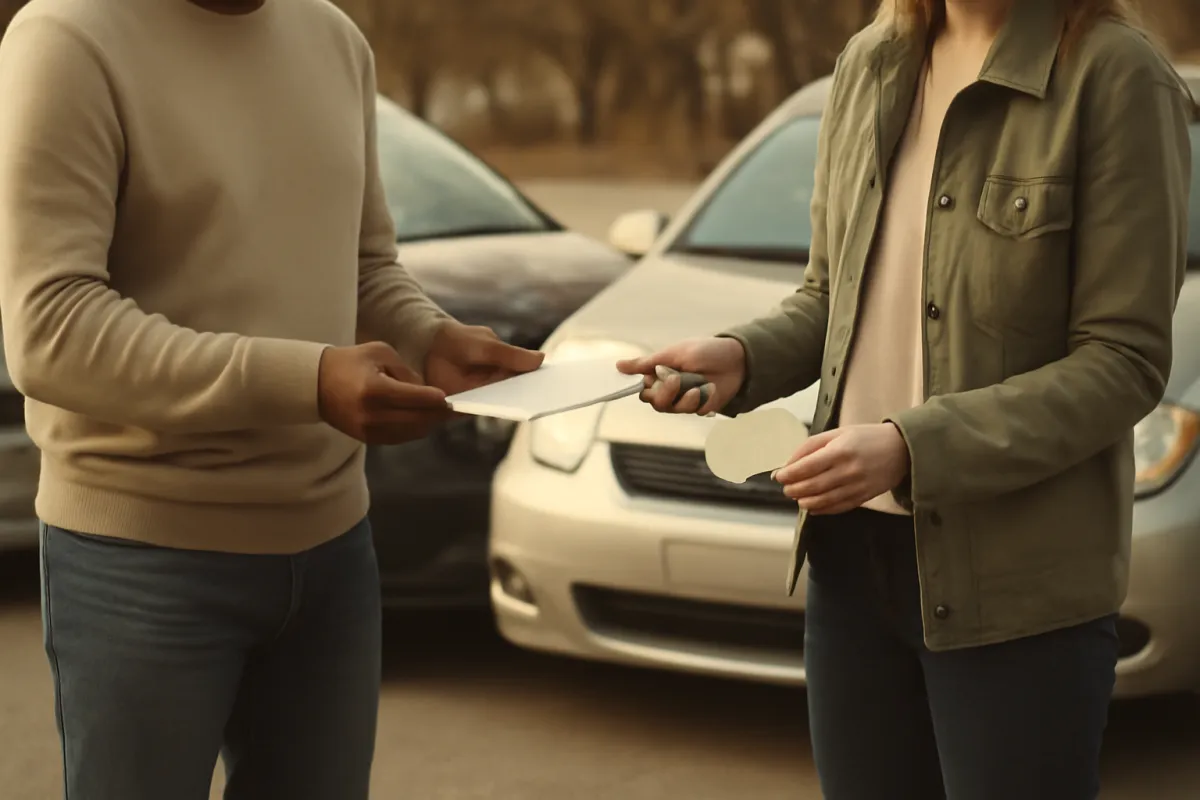
Fault does not change the fact that you and the other driver must trade details, so exchange information calmly and completely, because a claim missing basic information stalls before it starts. Collect the other driver’s full name, phone number, and address; their insurance company and policy number; and the vehicle’s make, model, color, year, and license plate. Photograph their insurance card and driver license if they will allow it, since a photo removes the transcription errors that later send a claim into limbo. If the driver is not the vehicle’s owner, note that too, because the policy that responds may belong to someone else.
Give the same basic details in return: your name, contact information, and insurer. You are generally not required to hand over more than your license, registration, and insurance information, and you do not owe the other driver a recorded account. Keep the exchange businesslike and brief.
Watch out, because this is the single most dangerous moment in the whole sequence for your claim: do not admit fault. Do not apologize, do not say I did not see you, and do not agree that the crash was your fault, because a reflexive apology gets quoted back as an admission and fault directly reduces or bars recovery in many states. You often do not have the full picture at the scene, and what feels like ordinary courtesy becomes evidence later. Say what you know factually, not what you assume about blame. If the other driver becomes hostile or refuses to share information, do not escalate; step back, let the police mediate the exchange, and rely on the report and the plate number you photographed. Collect what you can, stay factual, and let the evidence rather than the conversation carry things forward.
Step 5: Document the scene with photos, video, and witnesses
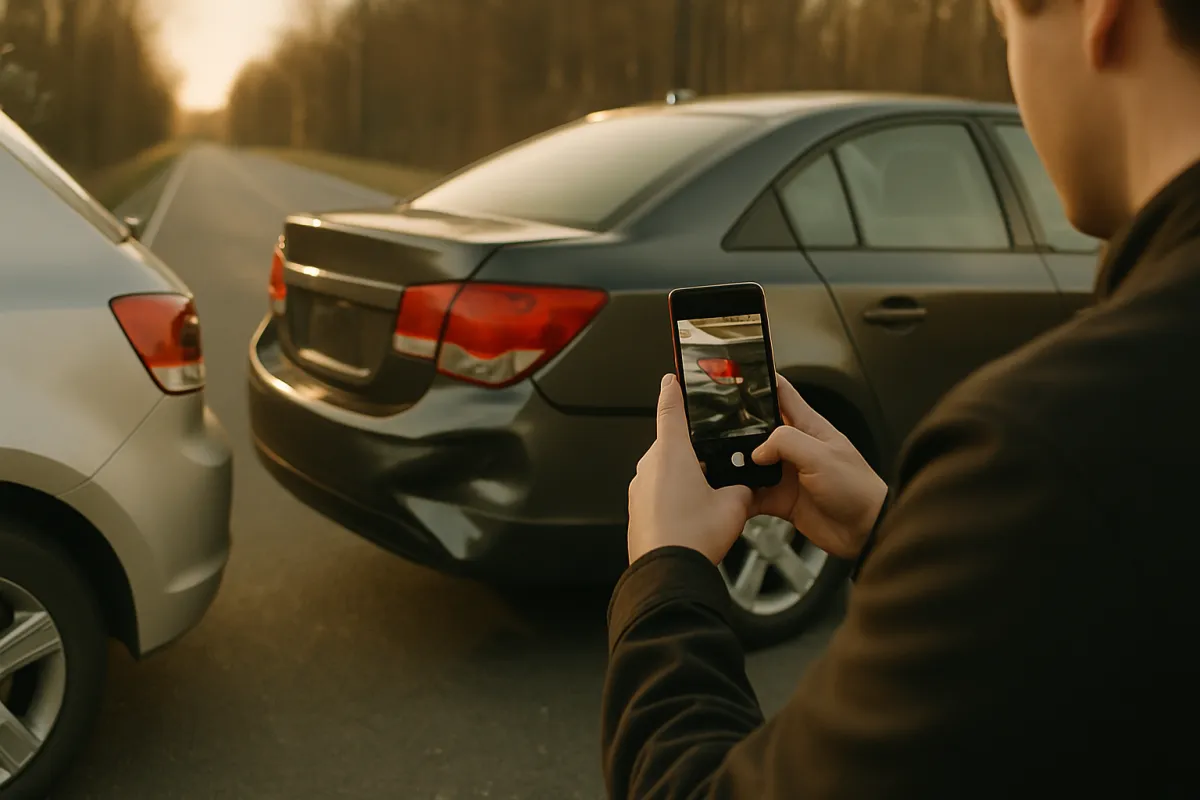
While you are still at the scene and safely out of traffic, become its documentarian, because the evidence you capture in the next ten minutes is evidence you can never recreate once the cars are towed and the road is cleared. Use your phone to photograph everything: the damage to both vehicles from multiple angles and distances, the wider scene showing how the cars came to rest, skid marks, debris, traffic signals and signs, the road surface, and the weather and lighting. Take more images than feel necessary. A short video panning across the whole scene captures context that individual photos miss, and it timestamps your record.
Beyond the vehicles, gather the human evidence. If there are witnesses, politely ask for their names and phone numbers before they leave, because an independent account is one of the most persuasive things a claim can carry and witnesses scatter within minutes. Note the time, the exact location, the direction each vehicle was traveling, and anything the other driver says. Write down your own recollection as soon as you can, since memory of a sudden event decays within hours. If any nearby business or home might have a camera pointed at the road, note that too.
Watch out: photograph conditions, not conclusions, and protect any dashcam footage immediately by saving it off the device so it is not overwritten. Capture the wet road and the signal you saw, but resist narrating fault in your notes or out loud, because fault is decided later on the full picture. Illustratively, a driver who leaves with a dozen clear photos, a scene video, and two witness numbers walks into the process with a documented base, while one with a single blurry image is negotiating on their word alone. The chart later in this explainer breaks down what your documentation should cover; the short version is that this step is where a strong claim is actually built.
Step 6: Seek medical attention even if you feel fine
Get checked by a medical professional even if you feel completely fine, because adrenaline masks injury and a gap between the crash and your first visit is the single most reliable way to weaken an injury claim. Some of the most common crash injuries, soft-tissue strains like whiplash and certain back injuries, commonly surface a day or two later, once the shock wears off. If anything feels wrong at the scene, accept the ambulance. If not, still see a doctor, an urgent care clinic, or your own physician within a day or two rather than waiting to see whether it passes.
When you are seen, describe every symptom rather than toughing it out, including the vague ones like headaches, dizziness, stiffness, or trouble sleeping, because a symptom you do not mention is a symptom that is not in your record. Follow the treatment plan you are given, and keep every record from the first visit forward: bills, receipts, diagnoses, prescriptions, and appointment notes. That medical record is the documented spine of any injury claim, and it is far easier to build in real time than to reconstruct months later.
Watch out: consistency matters as much as care itself. A delay before your first visit, and later any unexplained gaps between appointments or a course of therapy you stop early, all read on paper as evidence you recovered, whatever the truth. If you must pause treatment, have a documented reason. This is also why you should never settle before your treatment stabilizes, the point often called maximum medical improvement, because a delayed injury that emerges after you sign is usually a cost you cannot reopen. Feeling fine at the scene is normal; it is not proof you were not hurt, and treating it as proof is a mistake that quietly closes doors.

Step 7: Notify your insurer and start the claim
As soon as you are safe, notify your own insurance company, regardless of who was at fault, because nearly every policy requires prompt notice and reporting late can jeopardize your coverage. Use the claims phone line, mobile app, or website. Have your policy number, the basic facts, the police report number, and your scene photos ready. Notifying your insurer is not the same as admitting anything; it is putting your company on notice that an incident occurred, which is a duty you owe under the contract you already pay for through premiums.
Give a factual account: date, time, location, the vehicles involved, and what happened, in plain terms. Provide the police report number and offer your photos. If you carry coverages like collision, medical payments, or uninsured-motorist protection, this early notice is what activates your ability to use them. Ask the representative what your policy requires of you next, and write down the answer along with the name of everyone you speak with and the date of each call. When you formally open the claim, ask directly for your claim number and the adjuster’s name, and keep them at the top of a running file. Our step-by-step explainer on filing a car accident claim walks through that filing process in full once you reach it.
Watch out: promptly does not mean recklessly. Report the facts you know, but do not speculate about your injuries, your speed, or fault, because early guesses get frozen into the file and used later. If the other driver’s insurer calls asking for a recorded statement, you are generally not obligated to give one on the spot, and you can decline until your records are together or you have spoken with an attorney. Whether you also pursue the other driver’s insurer depends on fault and whether your state uses a no-fault or at-fault system, which is a genuine state-by-state difference, so confirm how yours works rather than assuming. Note your policy’s notice deadline now; it is short and rarely forgiven.
Step 8: Know your next steps and when to talk to a lawyer
Once the scene is behind you and your insurer is notified, the response shifts from minutes to weeks, and knowing the shape of what comes next keeps you from being rushed. In the days after, keep documenting: continue any treatment without gaps, log every bill and missed workday, and keep your claim number on every piece of paper. The vehicle side often moves first and separately, through a repair estimate you can question if it looks low. The injury side moves slower, because it should not be resolved until your treatment stabilizes and the full cost is actually known. When the conversation eventually turns to what the claim is worth, our car accident settlement explainer and, for the common rear-impact case, our rear-end collision settlement explainer show how the underlying number is built, and you can run illustrative figures through the settlement range estimator.
The most important next-step skill is recognizing when the situation has outgrown a do-it-yourself response. For a minor crash with clear fault, modest damage, and a full recovery, many people handle the claim themselves. But serious or lasting injuries, disputed fault, an uninsured or hit-and-run driver, a denied claim, or any offer you do not understand are all signals to at least talk to a licensed attorney. Most personal-injury attorneys offer a free consultation and work on contingency, so asking usually costs nothing.
Watch out: the first settlement offer is rarely the best, and the pressure to accept it quickly is the point, because an early number costs the insurer little and anchors the rest of the conversation downward. Our explainer on negotiating an injury settlement covers reading and countering that opener. Do not sign a release until you understand it usually ends the claim for good, including future costs from an injury that has not fully surfaced. Treat any offer as information, not a verdict, and when the stakes climb, put your specific facts in front of a licensed attorney before you agree to anything.
The first hour after a crash, by priority
It helps to see the first hour as a set of priorities rather than a flat list, because when everything feels urgent at once, knowing what outranks what keeps you from doing the low-stakes task while a high-stakes one waits. The chart below ranks the immediate actions by illustrative priority, on one shared scale. It is about order of importance, not minutes on a clock.
The first hour after a crash, by priority
Illustrative priority weighting of the immediate actions, on one shared scale. Illustrative only, meant to show order of importance, not a schedule.
Bar widths are each action as a share of the highest priority, safety and injuries, on an illustrative ten-point scale. Safety always outranks the claim, and notifying your insurer, while important, can happen once you are somewhere calm. The point is the order, not the exact widths, which are illustrative.
The chart carries the lesson that separates a calm response from a panicked one: safety is not one task among many, it is the task that outranks all the others, and everything below it exists only if the people are safe first. Notice too that two of the top three priorities, calling the police and documenting the scene, are about creating a neutral record, because the record is what the entire later process runs on. Exchanging information and notifying your insurer matter, but they can survive a few minutes of delay in a way that an unphotographed scene or an untreated injury cannot.
Documenting the scene: what to capture
Because documentation is where a claim is actually won or lost, it is worth breaking down what a complete scene record should cover, so you spread your ten minutes across the right things rather than taking twenty photos of one dent. The bar below splits an illustrative, complete scene record into its main pieces.
Documenting the scene: what to capture
Illustrative share of a complete scene record by type of evidence. The four shares sum to 100 and are illustrative only.
The four shares sum to 100 and are illustrative only. Damage photos are the largest piece because they are the most concrete, but the wider scene shots that show position and signals are what settle fault disputes, and the small witness slice is often the most persuasive evidence of all. Capture all four, not just the easy one.
The chart’s quiet warning is that people over-document the easy part and under-document the decisive part. Close-up damage photos are simple to take and feel productive, which is why most people take plenty of them, but a fault dispute is far more often resolved by a wide shot showing where the cars came to rest and which signal was green, or by an independent witness, than by another angle on a crumpled fender. The two smallest slices, driver information and witnesses, are the ones that vanish fastest as people leave the scene, so capture them first while you still can.
A worked example: the first hour of a rear-end collision
Numbers and names here are invented for illustration and promise nothing; the value is watching the eight steps run in real time. Picture a driver, call her Dana, stopped at a red light and rear-ended by a distracted driver who was reaching for a phone.
Step 1: Dana stays in her car for a moment, checks herself and finds no obvious injury, then checks her passenger, who is also shaken but unhurt. Neither needs an ambulance, but she keeps that judgment provisional. Step 2: she turns on her hazards, and because both cars are drivable and sitting in a live lane, she quickly photographs their positions and then pulls onto the shoulder, away from traffic. Step 3: she calls the police despite the other driver suggesting they just swap numbers, and when the officer arrives she gives a factual account and leaves with the incident number and the officer’s name.
Step 4: she exchanges names, insurers, policy numbers, and plates, photographs the other driver’s card and license, and when he says sorry, I was reaching for my phone, she simply notes it factually without arguing fault or accepting his apology as her own. Step 5: she photographs both bumpers from several angles, takes a short video panning across the intersection, captures the still-green signal for her lane, and gets a phone number from a bystander who saw the impact. Step 6: her neck stiffens overnight, so she sees a doctor the next morning, is diagnosed with whiplash, and starts a course of physical therapy, keeping every bill and note.
Step 7: that same evening she had already notified her insurer through the app, giving the incident number and uploading her photos, and she now opens the claim and records the claim number and adjuster’s name. Step 8: because her injury is a documented soft-tissue case with clear fault, she keeps treating without gaps and holds off on any settlement talk until her condition stabilizes, deciding she will consult an attorney if fault is disputed or the first offer looks low. Change any fact, a serious injury, disputed fault, an uninsured driver, and the picture shifts, which is exactly why the documentation from Steps 3 through 6 did the real work.
Common mistakes to avoid
These are the recurring errors that turn a manageable situation into a weak one, collected so you can recognize and skip them.
- Admitting fault at the scene. A reflexive apology or an I did not see you gets quoted back as an admission, and fault directly reduces or bars recovery in many states. Describe what happened factually and let the investigation assign blame.
- Not calling the police. Skipping the report, often at the other driver’s urging, leaves you with no neutral record when the story changes the next day. An official report number is one of the most useful things a claim can have.
- Skipping or delaying medical care. Feeling fine is not proof you were not hurt, and a gap between the crash and your first visit is the most common reason an injury claim gets discounted. Get checked promptly and describe every symptom.
- Failing to document the scene. Evidence you do not capture in the first ten minutes is evidence you can never recreate. A claim built on your word alone is far weaker than one built on photos, video, witnesses, and a report number.
- Accepting a quick cash offer. A handshake to keep insurance out of it almost always favors the person at fault, and it evaporates the moment a repair estimate or a delayed injury appears. The same caution applies to a fast first settlement offer.
- Posting about the crash on social media. A photo, a check-in, or an offhand I am fine post can be pulled out later to contradict an injury claim. Say nothing publicly about the accident, your injuries, or fault while a claim is open.
Every mistake here shares a root: acting on the impulse to be done quickly and to smooth things over, when the situation actually rewards being deliberate and factual. The people who come through a crash well are simply the ones who protected safety first, documented early, admitted nothing about fault, and refused to be rushed.
Troubleshooting: hit-and-runs, uninsured drivers, and late injuries
Real crashes throw curveballs, so here are the common ones and where to turn.
What if it was a hit-and-run and the other driver fled? First, do not chase them, because chasing turns one incident into two. Instead, capture what you can immediately: the plate if you saw it, the make, model, color, and direction of travel, and the time and location. Call the police right away, because a hit-and-run makes the report essential; it documents that you were not at fault and that the other party left. Look for witnesses and any nearby cameras. Then this is exactly what your own uninsured-motorist coverage is for, if you carry it, so notify your insurer and ask how that coverage applies.
What if the other driver has no insurance? An uninsured at-fault driver is a common and stressful situation, and again uninsured or underinsured motorist coverage is the answer if you have it, which in many states is standard or must be offered. Your own policy can stand in for the missing one, subject to your limits and your state’s rules. Document everything as you would normally, notify your insurer promptly, and because the coverage rules here are technical and state-specific, treat this as a strong reason to consult a licensed attorney early.
What if an injury shows up days or weeks later? Common injuries like whiplash and some back injuries surface after the adrenaline fades, so a delayed symptom is medically normal, but it is easier to connect to the crash the sooner you document it. See a doctor as soon as it appears, describe it clearly, and make sure the record ties it to the accident. This is also why settling too early is dangerous, because a release signed before a late injury emerges usually cannot be reopened. When a delayed injury is serious, slow down and get legal advice before agreeing to anything.
What if the other driver blames me? A fault dispute is not a final ruling; it is a claim to be met with evidence. This is where your photos, the police report, and any witnesses earn their keep. Many states use comparative-fault rules, where a share of blame reduces rather than erases recovery, so an accusation is a negotiating move, not a verdict. If a serious claim turns on disputed fault, an attorney can assess how your state’s rules apply.
What to do after a winter car accident
Winter does not add a ninth step. What it does is change the weight of the first two and the content of the fifth, and knowing that in advance is the difference between a cold, frightening scene handled in order and one handled by instinct. Everything else in the sequence, from the police report to notifying your insurer, runs exactly as written above.
Start with the safety judgment, because it is harder in winter. On ice, the vehicle that hit you may not be the last one to arrive, and the drivers behind it have the same stopping problem yours did. Turn on your hazards before anything else, and then make a deliberate choice: if the shoulder is icy, visibility is poor, or the road is fast, staying belted inside the car with the lights on can be the safer option, unless there is smoke, fuel, or a position in a live lane that makes getting out the lesser risk. Where you do get out, get well clear of the road rather than standing beside the cars. Reflective triangles matter more in winter than at any other time, placed further back than feels necessary, because a driver on a slick surface needs more room to react.
Cold is the hazard people underestimate. Help can take longer to arrive in bad weather, tow trucks are busiest exactly when you need one, and a shaken person standing in the wind loses heat faster than they realise. Keep everyone warm, keep the engine running only if the exhaust is clear of snow, and treat a passenger who is shivering, confused, or unusually quiet as someone who needs attention now rather than later. People first, metal second, applies with more force in January than in June.
Then adjust Step 5, because the evidence that decides a winter crash is the evidence that disappears fastest. Photograph the road surface where the impact happened and where each vehicle started to slide: ice, packed snow, slush, standing water, and whether the surface had been plowed, sanded, or salted. Capture the visibility as it actually was, the daylight or lack of it, whether snow covered the lane markings, and whether any sign or signal was obscured. Note the temperature if your dashboard shows it. A road crew can arrive within the hour and erase all of it, and a claim that turns on conditions is a claim that needs a record of them. Save any dashcam footage off the device immediately; the same clip that shows the impact also shows the road.
Winter fault questions: ice, snow, and the reasonable-driver standard
The most common thing said after a winter crash is some version of I slid, the road was ice, nobody could have stopped. It is worth understanding, before that sentence is spoken to anyone, how it tends to be treated.
Weather is generally not treated as an excuse in itself. The question a fault determination usually asks is whether each driver was travelling reasonably for the conditions that existed, and a driver who was going too fast for ice, following too closely for the stopping distance the surface allowed, or driving on tires that could not hold the road can be found at fault even though the ice did the sliding. How that standard is applied, and how a shared share of fault reduces or bars recovery, varies by state, so treat this as the shape of the argument rather than a rule. Our comparative negligence explainer covers the sharing mechanics, and a licensed attorney in your state can tell you how they apply to your facts.
The practical consequence is that Step 4 becomes even more important in winter. Describing what happened factually, I was in the right lane at this speed and the car behind me did not stop, is different from characterising it, and the difference is exactly what an adjuster will read later. The other driver’s own remark about the ice can be noted factually too. Let the road surface photographs, the report, and any witness carry the argument about conditions.
Two winter scenarios deserve their own note. A multi-vehicle chain collision on ice can involve several drivers and several insurers, and fault is often allocated across the sequence rather than landing on one person. Your position in that sequence, which car struck you and which you struck, and whether you were stopped or moving at each impact, is the information that matters, so record it while you still remember it. An animal strike on a winter road is usually handled differently from a collision with another vehicle, and our note on hitting a deer and who pays covers that version. In both cases the report from Step 3 is what fixes the sequence, which is why calling the police is worth the wait even when the damage looks modest.
Holiday-season crashes: rental cars, out-of-state drivers, and impaired-driver suspicions
The weeks around the holidays bring a cluster of situations that the ordinary steps do not spell out, and each one adds a line to your file rather than changing the order.
The other driver is in a rental or a borrowed car. The policy that responds may belong to the rental company, to the renter’s own insurer, or to the vehicle owner rather than the person driving, so collect the extra layer: the renter’s own insurance details, a photograph of the rental agreement if they will show it, and, for a borrowed car, the owner’s name and insurer. Do not guess at which policy applies; note everyone involved and let the insurers sort the order. Our rideshare accident explainer covers the parallel question for a driver working when the crash happened.
The other driver is from out of state. The exchange in Step 4 is the same, but confirm the insurer’s name and policy number carefully rather than relying on a card from an unfamiliar company, and photograph the licence plate and the state on it. Which state’s fault and notice rules apply can be a genuine question when drivers, vehicles, and the crash are spread across jurisdictions, and it is one for an attorney rather than a roadside decision.
You suspect the other driver is impaired. Do not confront them and do not try to detain them. Tell the dispatcher what you observed, factually, when you call the police in Step 3, and note the specific observations for your own record: speech, balance, smell, what they said. An officer’s assessment at the scene is the evidence that matters; your accusation is not. If they attempt to leave, note the plate and direction of travel and let the police handle it, as with any hit-and-run.
Everything is slower. Insurer claims lines, body shops, and clinics run reduced hours around the holidays. That does not change your policy’s notice requirement, so report through the app or the claims line as usual and keep a note of the date and time you did. If your own doctor is closed, an urgent care visit still starts the medical record in Step 6, and the gap that weakens a claim is the gap you leave, not the gap the calendar leaves.
Cold masks injury. Stiffness the next morning is easy to write off as the cold or as sleeping badly, and that is exactly how a whiplash injury goes undocumented for a week. Treat any new stiffness, headache, or pain after a winter crash as something to have looked at, the same day if you can.
None of the above is a reason to skip a step or to reorder one. It is a set of extra facts to capture at the moment they are available, because a rental agreement, an out-of-state plate, and an officer’s observation of impairment are all easier to record at the scene than to reconstruct in February.
Your after-a-crash checklist
Save this compact list and work it in order. Print a copy for your glovebox.
- Stopped and stayed at the scene; hazards turned on
- Checked yourself, passengers, and the other vehicle for injuries
- Called 911 if anyone is hurt or vehicles block traffic
- Moved drivable vehicles out of live traffic once safe
- Photographed original positions before moving, if safe to do so
- Police called; officer name and report or incident number recorded
- Other driver’s name, contact, insurer, policy number, and plate collected
- Their insurance card and license photographed
- No admission of fault made to anyone, no apology accepted as your own
- Scene documented: damage, positions, road, signals, weather, plus a video
- Winter: road surface, plowing or treatment, visibility, and obscured markings photographed
- Witness names and phone numbers collected before they left
- Dashcam footage saved off the device
- Medical care obtained promptly; every symptom described
- All bills, receipts, and appointments logged from day one
- Your own insurer notified promptly, with report number and photos
- Claim number and adjuster contact recorded on a running file
- Nothing about the crash posted on social media
- Attorney consulted if injuries, fault, coverage, or a denial are in play
The bottom line
What to do after a car accident is not a mystery; it is a sequence, and the sequence has an order for a reason. Stop and protect people before property, move to safety and warn oncoming traffic, call the police and get a report, exchange information without admitting fault, document the scene while it still exists, get medical care even if you feel fine, notify your insurer promptly, then plan your next steps and know when the situation has outgrown a do-it-yourself response. Do those eight things in order and you protect both the people involved and, later, a claim that is as strong as your facts allow. The two habits that separate a good outcome from a bad one are the same at every step: put safety first, and refuse to be rushed into saying or signing something you cannot take back. When a crash carries injuries, disputed fault, an uninsured driver, or a denied claim, stop improvising and put your specific facts in front of a licensed attorney in your state, who can tell you what an explainer cannot.
A closing word in our own voice: this explainer describes the general sequence of what to do after a car accident so you can act with order instead of panic, and that is the whole of what it does. It is not legal advice, it creates no attorney-client relationship, and it cannot account for the reporting duties, coverage requirements, comparative-fault laws, and filing deadlines that differ from one state and one insurer to the next and change over time. Every figure, priority weighting, and worked example above is illustrative, invented to show the shape of the response, not to predict what any real crash or claim will involve. When your own accident carries injuries, disputed fault, an uninsured driver, or a denied claim, the sound move is to stop improvising and put your specific facts in front of a licensed attorney in your state, who can tell you what the steps here cannot.
Frequently asked questions
What are the first things to do after a car accident?
In the first minute, stop, protect life before property, and check yourself and your passengers for injuries. Call 911 if anyone is hurt or if vehicles are blocking traffic. If the cars are drivable and you are in a dangerous spot, move them out of live traffic and turn on your hazard lights. Then report the crash to the police, exchange information with the other driver without admitting fault, and document the scene with photos before anything is moved. Those first actions protect both the people involved and, later, the claim. The exact legal duties after a crash vary by state, so treat this order as the reliable shape of the response, not as legal advice for your specific situation.
Should I call the police after a minor car accident?
For anything beyond the most trivial bump, err toward calling the police, because an official report is one of the most useful documents a claim can have. Many states require a report when there are injuries or when property damage exceeds a dollar threshold, and many insurers ask for the report number when you file. Even for a minor crash, a neutral record of who was involved, what happened, and any citation issued can settle a fault dispute later that your memory alone cannot. If officers decline to respond to a minor collision, ask how to file a report yourself, since many states allow it within a short window. Reporting costs a few minutes; not reporting can cost the claim.
Should I admit fault after a car accident?
No. Avoid saying anything that admits or accepts fault, including reflexive apologies like sorry or I did not see you, because fault is a legal conclusion that depends on facts you may not have at the scene, and it directly reduces or bars recovery in many states. Stick to describing what happened factually rather than characterizing who was to blame. You are generally required to share your license, registration, and insurance information, but you do not owe the other driver an admission or a theory of the crash. Let the police report, the photos, and the investigation assign fault. What feels like ordinary politeness in the moment can be quoted back later as an admission.
What should I do if I feel fine after a car accident?
Get checked by a medical professional anyway, promptly, because adrenaline routinely masks injury and some of the most common crash injuries surface a day or two later. Soft-tissue injuries like whiplash often do not announce themselves until the next morning, and a gap between the crash and your first visit is one of the most reliable ways an injury claim gets discounted. Seeing a doctor early both protects your health and creates the medical record that documents any injury tied to the accident. Describe every symptom rather than toughing it out, and follow the treatment plan you are given. Feeling fine at the scene is normal and is not proof that you were not hurt.
What information should I exchange after a car accident?
Collect the other driver's full name, phone number, and address; their insurance company and policy number; and the vehicle's make, model, color, year, and license plate. Photograph their insurance card and driver license if they allow it, since a photo removes the transcription errors that later stall a claim. Give the same basic details in return: your name, contact information, and insurer. You are generally not required to hand over more than your license, registration, and insurance information, and you do not owe a recorded account or an admission of anything. If the driver is not the vehicle owner, note that too, because the policy that responds may belong to someone who was not behind the wheel.
What if the other driver has no insurance or leaves the scene?
This is what uninsured and underinsured motorist coverage exists for, if you carry it, and in many states it is standard or must be offered. If the at-fault driver has no insurance or cannot be identified, as in a hit-and-run, you may turn to your own uninsured-motorist coverage to stand in for the missing policy, subject to your limits and your state's rules. A hit-and-run makes the police report essential, because it documents that you were not at fault and that the other party fled. Try to capture the plate, vehicle description, and direction of travel, and look for witnesses or nearby cameras. The coverage rules here are technical and state-specific, so this is a strong reason to consult a licensed attorney early.
How long after a car accident do I have to file a claim?
Two different clocks run at once, and people confuse them. Your insurance policy asks you to report an accident promptly, often described as within a reasonable time or a set number of days, and reporting late can jeopardize coverage. Separately, a state statute of limitations sets the deadline to file a lawsuit, commonly cited in a two-to-three-year range but varying widely by state and by the type of claim. Missing the statute can bar your claim entirely, no matter how strong it is. Because both timelines vary and change over time, confirm your policy's notice requirement and your state's deadline early, ideally with a licensed attorney, rather than assuming.
Do I need a lawyer after a car accident?
Not always. For a minor crash with clear fault, modest damage, and a full recovery, many people handle the claim themselves by following the steps and documenting carefully. The calculus changes as the stakes rise: serious or lasting injuries, disputed fault, an uninsured driver, or a denied claim all raise the cost of a mistake and the value of professional help. Most personal-injury attorneys offer a free initial consultation and work on contingency, so weighing representation usually costs nothing and can clarify whether your situation is a do-it-yourself matter. When injuries or fault are genuinely in question, the honest move is to at least ask a licensed attorney in your state.
What should I do differently after a winter car accident?
The eight steps do not change; the safety weighting around them does. On ice or in low visibility the risk of a second collision is higher, so getting people out of the travel lane, or keeping them belted inside a car with hazards on where stepping out is the more dangerous choice, comes before anything else. Cold exposure is its own hazard while you wait for help, which can take longer in bad weather. For the claim, photograph the road surface and the visibility as they were, including ice, snow cover, whether the road was plowed or treated, and whether lane markings or signs were obscured, because those conditions vanish within hours. Weather is generally not treated as an excuse for a driver, so a fault dispute after a winter crash usually turns on whether each driver was travelling reasonably for the conditions, and how that is judged varies by state, which is a question for a licensed attorney rather than for an explainer.

Hamza Hai is the editor of TortWise. She holds an MBA and reviews the site's articles against our editorial standards, checking that every figure is labelled for what it is, that nothing is presented as verified fact without a source the reader can check, and that the writing stays useful to a non-specialist.