
What's on this page
- What is premises liability?
- The four things you must prove in a premises liability claim
- Duty of care and who counts as a visitor
- Invitees: the highest duty of care
- Licensees: a middle duty of care
- Trespassers and the child exception
- Common premises liability cases
- Slip and fall accidents
- Inadequate or negligent security
- Falling objects and merchandise
- Dog bites and animal attacks
- Swimming pool and water accidents
- The notice question: did the owner know or should have known
- Proving causation and damages
- Comparative fault: how your own share reduces recovery
- How premises liability differs from general negligence
- What to do if you are injured on someone’s property
- How premises liability claims are valued
- A worked example: an illustrative store-fall claim
- Common misconceptions about premises liability
- When to consult a premises liability attorney
- The bottom line
Short answer: Premises liability is the branch of personal-injury law that holds a property owner or occupier responsible when an unsafe condition they knew or should have known about injures someone lawfully on the property. It is not automatic fault: the injured person must prove duty, breach, causation, and damages, and the duty owed depends on visitor status. Comparative fault can reduce a recovery. Rules differ by state, so consult a licensed attorney in your state.
Premises liability is the branch of personal-injury law that holds a property owner or occupier legally responsible when an unsafe condition on their property injures someone who was lawfully there. Put plainly, if you slip on an unmarked spill in a store, are hurt by merchandise that topples off a poorly stacked shelf, or are assaulted in a parking garage that had no working lights or locks, premises liability is the legal theory that asks whether the property owner should have prevented it. It is one of the most common and most misunderstood areas of injury law, because people assume an owner is automatically at fault whenever someone gets hurt on their property, and that is not how it works.
This article explains what premises liability actually is in plain English: the duty a property owner owes, how that duty changes with the kind of visitor you are (invitee, licensee, or trespasser), the four elements you have to prove, the common case types from slip and fall to inadequate security to dog bites, how comparative fault can reduce a recovery, how the theory differs from ordinary negligence, and what to do if you are injured on someone else’s property. It pairs with our deeper breakdowns of what a slip and fall settlement is worth, what to do after a slip and fall, and whether you need a slip and fall lawyer. Every dollar figure below is illustrative, and none of this is legal advice: laws vary by state, so confirm the specifics for your situation with a licensed attorney. You can run an illustrative range through our settlement estimator as you read.
Key takeaways
- Premises liability makes a property owner or occupier responsible for injuries caused by an unsafe condition they knew or should have known about, but it is not automatic fault: the injured person has to prove it.
- A premises claim generally rests on four elements: duty, breach, causation, and damages, and missing any one of them typically defeats the claim.
- The duty owed has traditionally depended on your visitor status, with an invitee (like a customer) owed the most, a licensee (like a social guest) owed a middle duty, and a trespasser owed the least, subject to exceptions such as child trespassers near a pool.
- Common cases include slip and fall, inadequate security, falling objects, dog bites, and pool accidents, and comparative fault can reduce a recovery when the injured person was partly to blame.
- Figures here are illustrative and this is educational only, not legal advice: premises rules differ by state, so consult a licensed attorney about your own claim.
What is premises liability?
Premises liability is a legal doctrine that assigns responsibility for injuries to the person who owns or controls a piece of property when a dangerous condition on that property causes harm. The controlling idea is one of reasonable care: someone who invites the public into a store, rents out an apartment, or opens a business to customers takes on a legal duty to keep that space reasonably safe and to address, or at least warn about, hazards they know of or should have discovered. When they fail that duty and someone is hurt as a result, the injured person may have a premises liability claim against them.
The word premises simply means the land and the structures on it, and liability means legal responsibility, so premises liability is responsibility arising from the condition of a property. It applies to a sweeping range of settings: grocery and retail stores, restaurants, hotels, apartment complexes, office buildings, parking lots and garages, private homes, government buildings, construction sites, and amusement venues. The responsible party is usually the owner, but it can also be a tenant, a property manager, or a business that occupies and controls the space, since the duty follows control of the premises rather than a deed alone.
What premises liability is not is a guarantee. An owner is not an insurer of everyone’s safety, and the law does not make them pay simply because an accident happened on their land. The injured person generally has to show that a hazardous condition existed, that the owner knew or reasonably should have known about it, that the owner failed to fix it or warn about it in a reasonable time, and that this failure caused a real injury. That gap between “I was hurt here” and “the owner is legally responsible” is the whole subject of this article.
The four things you must prove in a premises liability claim
Like any negligence-based claim, a premises liability case is built on four elements, and understanding them turns a vague sense of unfairness into a concrete legal question. The four are duty, breach, causation, and damages, and a claim generally needs all four to succeed. Think of them as a chain: a weakness in any single link can break the whole claim, which is why insurers probe each one.
Duty is the legal responsibility the owner owed you. On a property, that duty is to use reasonable care to keep the premises safe for the people lawfully present, and its exact scope can depend on why you were there, which the visitor categories below explain. Breach is the failure to meet that duty: the owner created the hazard, or knew about it and did nothing, or should have discovered it through reasonable inspection and failed to. This notice question, whether the owner knew or should have known, is usually the most contested element in the entire case, and it is where most premises claims are won or lost.
Causation connects the breach to the harm. It is not enough that the property was unsafe and that you were injured; the unsafe condition has to be what actually caused your injury, and the defense will look for other explanations, a pre-existing condition, a misstep unrelated to the hazard, an injury that happened elsewhere. Damages, the fourth element, means you suffered real, provable losses: medical bills, lost income, out-of-pocket costs, and non-economic harm like pain and reduced quality of life. Our explainer on how to document an injury claim covers how to build the evidence that supports the causation and damages elements, and you can sketch an illustrative value in the companion below.
Duty of care and who counts as a visitor
The duty a property owner owes has traditionally varied with the reason you were on the property, and the common law sorts people into three categories. Your status matters because it can change how much protection the law extends to you, so knowing where you fall is a useful first step in understanding a claim. The categories are invitees, licensees, and trespassers, and the table below summarizes the general duty owed to each. Treat it as the classic framework rather than a precise statement of any one state’s law.
| Visitor type | Who they are | Duty generally owed |
|---|---|---|
| Invitee | On the property for the owner’s benefit or by public invitation: a store customer, a hotel guest, a tenant | The highest duty: keep the property reasonably safe and inspect for hidden hazards, then fix or warn |
| Licensee | On the property with permission for their own purpose: a social guest, a friend visiting | A middle duty: warn of known dangers that the visitor is unlikely to discover |
| Trespasser | On the property without permission | The lowest duty: generally only to avoid willful or wanton harm, with a notable exception for child trespassers |
The reason the categories exist is a rough sense of fairness about foreseeability and benefit. A business that invites the public in for its own profit is expected to actively look for and address dangers, while a homeowner hosting a friend is expected to warn about known traps but not to run constant inspections, and someone who sneaks onto land uninvited is owed the least because their presence was not anticipated. Importantly, many states have modernized this scheme, some merging invitees and licensees into a single “lawful visitor” owed a general duty of reasonable care, so the three-tier model is a starting point, not a universal rule. The sections that follow walk through each category, and your own state’s version is what actually governs your claim.
Invitees: the highest duty of care
An invitee is the visitor category owed the most protection, and it covers most of the situations people picture when they think of premises liability. You are generally an invitee when you are on a property for a purpose connected to the owner’s business or by an invitation extended to the public: a customer shopping in a store, a diner in a restaurant, a guest in a hotel, a client in an office, or a tenant in a leased apartment. Because the owner benefits from your presence, or has opened the space to the public, the law asks more of them in return.
Toward an invitee, an owner generally owes a duty not only to fix or warn about hazards they actually know about, but also to make reasonable inspections to discover hidden dangers they should find, and then to address them. This is the crucial extra layer: an invitee does not have to prove the owner had actual knowledge of a hazard if the owner should have discovered it through the kind of routine inspection a reasonable business would perform. A grocery store, for instance, is generally expected to check its aisles for spills on a reasonable schedule, so a puddle left for an hour can support a claim even if no employee actually saw it.
That said, the duty is still one of reasonable care, not perfection. Owners are generally not liable for hazards that are truly open and obvious, that appear suddenly with no reasonable chance to discover them, or that a visitor could easily have avoided with ordinary attention, though states treat the open-and-obvious question differently. The invitee category is where the notice question and the comparative-fault question both get their fullest workout, which is exactly why so many premises claims involve customers hurt in stores.
Licensees: a middle duty of care
A licensee occupies the middle rung of the traditional framework, owed more than a trespasser but less than an invitee. You are generally a licensee when you are on a property with the owner’s permission but for your own purposes rather than the owner’s benefit. The classic example is a social guest: a friend you invite to a barbecue is on your property because they want to be there and you have allowed it, not because their presence profits you. Other examples can include someone taking a permitted shortcut or a guest at a private gathering.
Toward a licensee, an owner generally owes a duty to warn of known dangers that are not obvious and that the licensee is unlikely to discover on their own. The key difference from the invitee duty is the inspection obligation: an owner usually does not owe a licensee the same active duty to inspect for and root out hidden hazards. If a homeowner knows the second step of the back deck is rotten and a guest is likely to use it, the duty is to warn or fix it; but the homeowner is generally not expected to conduct the systematic safety inspections a business owes its customers. The owner still cannot set traps or willfully create dangers, of course.
This middle status is why an injury at a friend’s house can be legally different from the same injury at a store, even though the physical accident looks identical. A social guest who trips on a hazard the host did not know about and had no duty to inspect for may have a weaker claim than a customer who trips on the same kind of hazard in a shop. As with every category, several states have collapsed the licensee and invitee distinction into a single reasonable-care standard, so confirm how your state treats social guests before drawing conclusions.
Trespassers and the child exception
A trespasser is someone on a property without permission, and this category is owed the least under the traditional rules. Generally, an owner’s only duty toward a trespasser is to refrain from willful or wanton conduct that would injure them, meaning the owner cannot deliberately set dangerous traps but is usually not responsible for ordinary hazards a trespasser stumbles into. The logic is that an owner cannot reasonably be expected to make their property safe for people they did not invite and did not expect. Someone who climbs a fence into a closed yard and is hurt on uneven ground usually has a difficult claim.
The most important qualifier is the attractive nuisance doctrine, which many states apply to child trespassers. The idea is that children may be drawn onto a property by something both appealing and dangerous that they are too young to appreciate the risk of, the classic example being an unfenced swimming pool, but also things like trampolines, machinery, or abandoned appliances. Where the doctrine applies, an owner can owe a duty to take reasonable steps to protect foreseeable child trespassers from such a hazard, for instance by fencing a pool, even though the children were not invited. This is why pool safety and fencing come up so often in premises liability.
There are other narrower situations where a duty can extend to trespassers, such as when an owner knows people regularly cross a particular spot and a hidden danger exists there. The broad point, though, is that the trespasser category is the weakest footing for a premises claim, and the child exception is the most significant carve-out. State law varies considerably on all of this, so the presence or absence of a duty toward someone who was not invited is a question for a licensed attorney familiar with your jurisdiction.
Common premises liability cases
Premises liability is defined by the legal theory, not by a single kind of accident, so it spans a wide range of injuries that share one thread: an unsafe property condition the owner was responsible for. The chart below sketches the rough relative frequency of the best-known case types, on one shared illustrative scale where a longer bar means the type comes up more often in practice. The weights are illustrative, meant to show proportion rather than to report any measured statistic.
Common premises liability case types
Illustrative relative frequency of the best-known premises liability claims, on one shared scale. Illustrative only, not a measured statistic.
Bar widths are each type's illustrative frequency as a share of the most common (slip, trip, and fall). Falls dominate the category, followed by security, falling objects, and animal cases, with pool accidents rarer but often severe. The ranking is illustrative and not a measured figure; any given property, region, or year can differ. What unites all of them is an unsafe condition the owner knew or should have known about.
The sections that follow take the top case types one at a time, because the notice question and the evidence look different in each. Falls turn on how long a hazard was present; security cases turn on foreseeability of crime; falling-object cases turn on how merchandise was stacked; animal cases turn on the owner’s knowledge and local statutes; and pool cases turn on fencing and supervision. Across all of them, the same four elements, duty, breach, causation, and damages, still have to be proven, which is what makes them one legal family rather than five separate topics.
Slip and fall accidents
The slip, trip, and fall is the archetypal premises liability case, and it is by far the most common. It happens when a walking-surface hazard causes someone to lose their footing: a wet or freshly mopped floor, a spilled liquid, ice or snow at an entrance, a torn mat or rug, an uneven or broken step, a pothole in a parking lot, poor lighting, or an object left in a walkway. The injuries range from bruises and sprains to fractures, and to back, neck, and head injuries that can be serious and slow to reveal themselves.
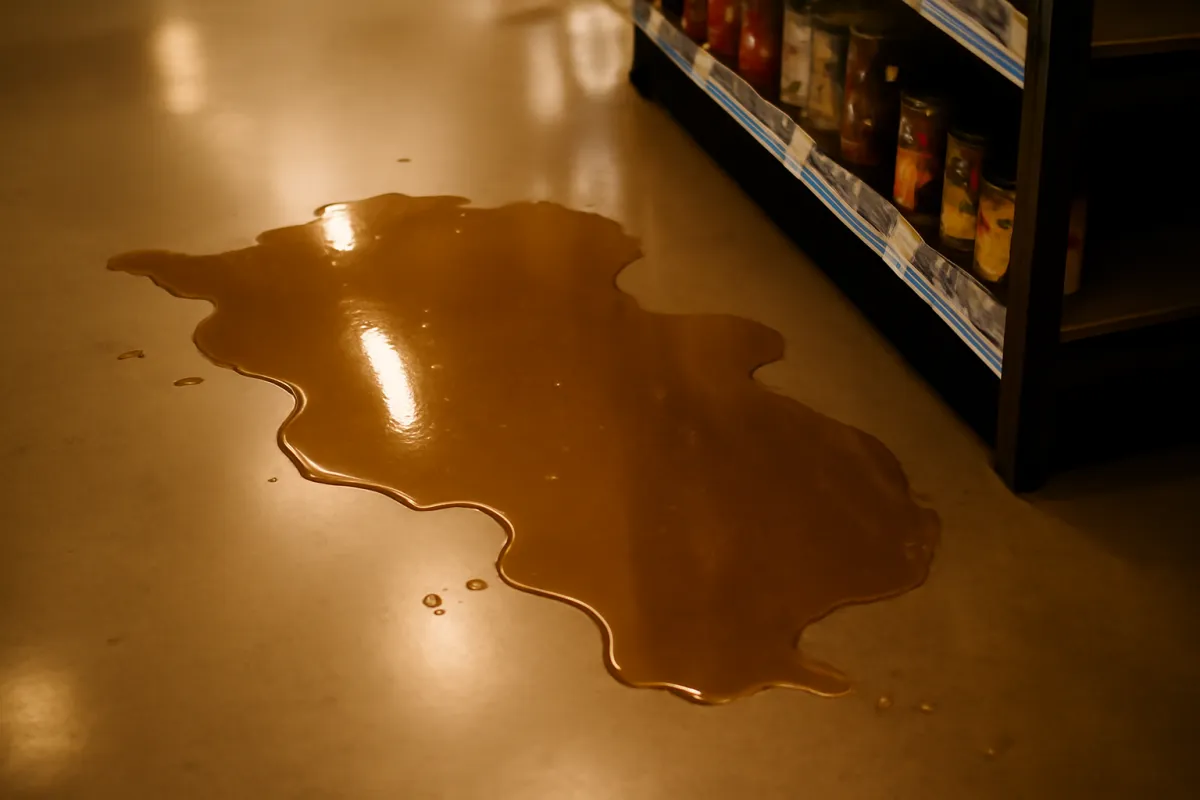
What makes fall claims legally interesting is that the accident itself rarely proves fault. The decisive question is almost always notice: had the hazard been present long enough that the owner, using reasonable care, should have found and fixed it? A spill that a customer created thirty seconds before your fall may not support a claim, because no reasonable inspection would have caught it yet, while the same spill left for an hour with employees walking past it points to a clear failure. Because the facts that decide this, how long the hazard existed, whether staff knew, whether inspections happened, live in the property’s own records and camera footage, preserving that evidence quickly is often decisive.
Falls are covered in depth in our companion pieces on what a slip and fall settlement is worth and what to do after a slip and fall. This article stays at the level of the broader premises doctrine that falls belong to, so if a fall is your situation specifically, those explainers go deeper on valuation and immediate steps.
Inadequate or negligent security
Inadequate security, sometimes called negligent security, is a premises liability theory that looks unlike a fall but rests on the same duty. It arises when someone is harmed by the criminal act of a third party, an assault, a robbery, an attack, in a place where the property owner failed to provide reasonable security against a foreseeable danger. The claim is not that the owner committed the crime, but that the owner’s failure to take reasonable precautions made a foreseeable crime possible. Common settings include parking garages, apartment complexes, hotels, bars, and shopping centers.
The pivotal concept here is foreseeability. An owner is generally not liable for every unpredictable crime, but where prior incidents, the surrounding area, or the nature of the business made criminal activity reasonably foreseeable, the duty to take reasonable protective measures can attach. Those measures might include adequate lighting, functioning locks and gates, security cameras, or trained personnel, depending on the setting. A poorly lit apartment parking lot with a history of break-ins, for example, presents a very different foreseeability picture than an isolated, unpredictable event with no warning signs.
Negligent security cases tend to be fact-intensive and heavily contested, because the defense will argue the crime was not foreseeable and that the intervening criminal act, not the owner’s security choices, is the true cause. Establishing a pattern of prior incidents, industry-standard security practices, and the specific lapse that mattered usually takes investigation and, often, expert input. These are among the premises cases where professional help matters most, and where the general principles here are only a starting point for a much more detailed legal analysis that depends heavily on state law.
Falling objects and merchandise
Falling-object cases are a staple of retail premises liability, especially in warehouse-style stores where heavy merchandise is stacked high overhead. The claim arises when an item falls from a shelf, a display, or an overhead rack and strikes a customer, causing injuries that can be significant given the weight and the distance. The theory is the familiar one: the owner had a duty to store and display merchandise safely, breached it by stacking or securing goods carelessly, and thereby caused the injury.
These cases often turn on how the merchandise was stacked and whether the retailer followed reasonable safety practices for overhead storage. Evidence can include the store’s own stocking policies, the condition and arrangement of the shelving, whether items were secured or restrained, and whether staff had reason to know a display was unstable. As with falls, the notice element can matter: a display that had been visibly precarious for some time presents a stronger claim than one disturbed by another shopper moments earlier. Surveillance footage and incident reports frequently carry the case.
Falling-object claims illustrate how premises liability adapts to the specific hazard while keeping the same skeleton. The duty, keep the premises reasonably safe, is constant, but what counts as a breach depends on the setting: a wet floor for a fall, an unforeseeable crime for security, an unstable stack for falling merchandise. Recognizing that the same four elements underlie each type is what lets you reason about a premises injury you have never seen categorized before, rather than treating every accident as its own mysterious rule.
Dog bites and animal attacks
Dog bites and other animal attacks can fall under premises liability when they happen on the owner’s property, though this is an area where a separate body of law often overlaps. Many states have specific dog-bite statutes, some imposing strict liability on the owner regardless of whether the dog had shown aggression before, others following a version of the older rule that an owner is liable if they knew or should have known the animal was dangerous. Where the attack happens on the owner’s premises, premises principles about lawful visitors and the duty of care can also come into play.
The practical questions in an animal case often include whether the injured person was lawfully on the property, whether the owner knew of the animal’s tendencies, whether leash or containment rules were followed, and which state statute applies. A guest bitten by a dog the owner knew had bitten before presents a different claim than a trespasser bitten after ignoring a “beware of dog” sign, and the governing statute can change the analysis dramatically. Because the statutory landscape varies so much, this is a case type where confirming your state’s specific rule is essential.

We cover the valuation side of these claims separately in our explainer on what a dog bite settlement is worth. For the purposes of understanding premises liability, the point is that an animal attack on someone’s property is one of the recognized ways an unsafe condition, here a dangerous or uncontrolled animal, can create owner responsibility, subject to the specific statute that applies.
Swimming pool and water accidents
Swimming pool accidents are among the most serious premises liability cases, both because the injuries can be catastrophic and because they so often involve children. A pool is a hazard that demands particular care: the duty can include maintaining fences and self-latching gates, providing adequate supervision or warnings, keeping the deck and drains safe, and complying with local pool-safety and building codes. When those precautions fail and someone is injured or drowns, premises liability is the theory that examines the owner’s responsibility.
Pools are the textbook trigger for the attractive nuisance doctrine discussed earlier. Because a pool is exactly the kind of appealing but dangerous feature that can draw children who cannot appreciate the risk, an owner can owe a duty to take reasonable steps to keep foreseeable child trespassers safe, most commonly by fencing the pool, even though the child was not invited. This is one of the clearest illustrations of how premises liability bends its usual visitor categories to protect children, and it is why unfenced residential pools are such a recurring source of tragic claims.
Beyond the attractive nuisance context, pool cases involving invited guests, hotel and apartment pools, and public facilities apply the ordinary duty of reasonable care to a high-stakes hazard. Code compliance, supervision, signage, and the condition of ladders, drains, and surfaces all become part of the analysis. Because the stakes are so high and the law around child safety so specific, pool accident claims are among those where early, experienced legal help is most valuable, and where the general framework here is only the beginning of the analysis.
The notice question: did the owner know or should have known
If there is a single concept that decides premises liability cases, it is notice. For most hazards, the owner is not liable simply because a dangerous condition existed; they are liable when they knew about it, or should have known about it and failed to act within a reasonable time. This element is where the vast majority of contested premises claims are actually fought, because it is inherently arguable and because the evidence often sits in the owner’s hands.
Lawyers usually split notice into two kinds. Actual notice means the owner genuinely knew about the hazard, for example because an employee saw the spill or a tenant reported the broken lock. Constructive notice means the owner should have discovered the hazard through reasonable care, even if no one actually saw it, because it had been present long enough that a reasonable inspection would have caught it. Constructive notice is what makes the “how long was it there” question so central: a hazard present for an hour supports it, a hazard present for seconds usually does not. A third path, where the owner or its employees created the hazard themselves, can establish responsibility without separate proof of notice.
Because notice so often turns on timing and on records the property controls, the evidence that proves it, surveillance footage, inspection and maintenance logs, cleaning schedules, incident reports, and employee accounts, tends to be both decisive and perishable. Footage gets overwritten, spills get mopped, and steps get repaired, sometimes within days. That is why acting quickly to preserve evidence, or having a lawyer send a preservation letter, matters so much in premises cases, and why a well-documented claim is so much stronger than one built on memory alone.
Proving causation and damages
Even with a clear duty and an obvious breach, a premises claim still has to connect the hazard to a real, documented injury, and that is the work of the causation and damages elements. Causation asks whether the unsafe condition actually caused the harm you are claiming. The defense will look hard for alternative explanations: a pre-existing back problem, an injury that really happened elsewhere, or a fall caused by your own footwear rather than the hazard. Prompt medical care that ties the injury to the incident, and consistent treatment that documents its course, are what hold the causation link together.
Damages are the losses the injury caused, and they generally split into two halves. Economic damages are the documented, addable costs: medical bills, future medical care, lost wages, lost earning capacity, and out-of-pocket expenses. Non-economic damages cover the harder-to-quantify harms: pain, suffering, loss of enjoyment of life, and similar effects, which are often estimated in relation to the economic damages and the severity of the injury. Our explainer on what a personal injury claim is worth walks through how these two halves combine.
The practical lesson is that documentation is not paperwork for its own sake; it is the proof of two of the four elements. A hazard the owner clearly should have fixed still produces nothing without evidence tying it to an injury and evidence of what that injury cost you. This is why the same discipline that supports a fall or crash claim, prompt care, complete records, saved receipts, a dated account of how the injury has affected you, applies with equal force to any premises case. Enter your own documented costs in the companion below to see an illustrative value band.
Comparative fault: how your own share reduces recovery
One of the most important and least understood features of premises liability is comparative fault, the rule that reduces a recovery by the injured person’s own share of the blame. Property owners and their insurers routinely argue that you were partly responsible for your own injury: that you were looking at your phone, wearing unsuitable shoes, ignored a visible warning sign, or walked somewhere you should not have. These arguments do not have to be strong to matter, because in many states they directly reduce what a claim is worth.
Most states follow some form of comparative negligence. Under a pure comparative rule, your recovery is reduced by your percentage of fault no matter how high it is, so a claim worth an illustrative $20,000 with you 30% at fault yields roughly $14,000. Under the more common modified comparative rule, the same reduction applies, but you are barred from recovering anything once your share crosses a threshold, often 50% or 51%. A small number of states still apply a much harsher contributory-negligence rule, where being even slightly at fault can bar recovery entirely. Because the rule varies so sharply, the standard in the state where you were hurt is one of the most consequential facts in your claim.
How comparative fault reduces an illustrative recovery
Illustrative split of a claim where the injured person is found 30% at fault, under a comparative-fault rule. Illustrative only, never a prediction.
The two shares sum to 100. In this illustration a 30% fault finding reduces an otherwise-full recovery by 30%, so 70% remains. Under a modified-comparative rule, crossing a 50% or 51% threshold would eliminate the recovery entirely, and under a strict contributory rule any fault at all could. The percentage is illustrative; your state's rule and the facts decide the real split.
The takeaway is that comparative fault makes the defense’s version of events worth real money, which is why premises defendants invest so much in arguing you were careless. Answering those arguments credibly, with photos, witness accounts, and a clear account of the hazard, is part of what protects the value of a claim. Because these rules are so state-specific and so outcome-determinative, comparative fault is near the top of the list of things to confirm with a licensed attorney.
How premises liability differs from general negligence
People often ask how premises liability relates to plain negligence, and the honest answer is that premises liability is a specialized branch of negligence rather than a separate species. General negligence is the broad legal principle that a person who fails to use reasonable care and causes foreseeable harm can be held responsible, and it covers everything from a distracted driver to a careless contractor. Premises liability applies that same principle to a specific situation: injuries arising from the condition of a property, brought against the owner or occupier who controls it.
Because it is a branch of negligence, a premises case shares negligence’s four-element skeleton of duty, breach, causation, and damages. What distinguishes it are two features layered on top. The first is that the duty can vary with the injured person’s status as an invitee, licensee, or trespasser, a wrinkle that ordinary negligence does not have in the same form. The second is the central role of the notice question: proving that the owner knew or should have known about the hazard, which is the specific way breach usually has to be shown in a premises case. These two features are why premises liability is treated as its own topic even though it lives inside negligence law.
In everyday terms, the distinction rarely changes what you need to do, prove that a responsible party failed to use reasonable care and that it hurt you, but it does change the questions that matter. A negligence claim from a car crash centers on driving conduct; a premises claim centers on the property’s condition, who controlled it, why you were there, and whether the owner had notice. Understanding that premises liability is negligence-with-extra-features, rather than an unrelated body of law, makes the whole area much easier to reason about.
What to do if you are injured on someone’s property
If you are hurt on someone else’s property, a short list of practical steps protects both your health and any claim you might have, and the order matters. First, get medical attention. Your health comes first, and prompt care also creates the record that ties your injury to the incident, which is exactly the causation evidence a claim later depends on. Some premises injuries, especially to the back, neck, and head, can surface or worsen over days, so being checked promptly matters even if you feel able to walk away.
Second, if you are able, report the incident to the owner, manager, or landlord, and ask that a written incident report be made; get its reference number and the names of anyone involved. Third, document the scene before it changes. Photograph the hazard itself, the spill, the broken step, the missing sign, the poor lighting, along with the surrounding area, because premises evidence is cleaned up or repaired quickly. Collect the names and contact information of any witnesses, whose independent account can be powerful in a claim that would otherwise rest on your word alone.

Finally, preserve your own records and be careful early on. Keep every medical bill, record, and proof of missed work, and be cautious about giving a recorded statement to an insurer or accepting a fast settlement before you understand the full injury. Our step-by-step on how to document an injury claim covers assembling this file in depth. None of this is legal advice; if the injury is serious or liability is disputed, our explainer on how to find a personal injury lawyer can help you take the next step.
How premises liability claims are valued
Valuing a premises liability claim follows the same logic as valuing any injury claim, with the added twist that the strength of the liability case heavily influences what a claim can realistically settle for. The starting point is your economic damages: documented medical bills and lost wages, plus out-of-pocket costs. On top of that sits an estimate of non-economic damages for pain and suffering, often expressed as a multiple of the economic damages that rises with the severity and duration of the injury. Our settlement estimator sketches an illustrative range using that method.
What premises liability adds is that the value is filtered through the liability picture. A claim with clear notice, a strong causation link, and little comparative fault holds its value; a claim where notice is genuinely disputed, or where the owner can pin significant fault on you, is discounted to reflect the risk that a jury might not find the owner responsible at all. In other words, two identical injuries can be worth very different amounts depending on how strong the underlying premises case is, which is why the elements discussed above are not academic; they are the biggest lever on value.
Every figure in any valuation exercise is illustrative and pre-adjustment. A real settlement is also shaped by the at-fault party’s insurance policy limits, which can cap a claim regardless of its theoretical worth, by any statutory caps, and by the attorney fees and medical liens that come out of a gross settlement before you keep anything. Treat any number, including the ones the companion produces, as machinery for understanding proportion, never as a prediction. The honest answer to “what is my premises claim worth” is always a range that depends on facts only you and a licensed attorney can weigh.
A worked example: an illustrative store-fall claim
Numbers here are invented purely to show how the pieces fit; they promise nothing. Picture a shopper, call her Elena, who slips on a puddle of leaked liquid in a store aisle and fractures her wrist. Walk her claim through the four elements. Duty: she was a customer, an invitee, so the store owed her the highest duty, including reasonable inspection for hazards. Breach: the question is notice, and the store’s own footage shows the puddle spread on the floor for roughly forty minutes with two employees passing it, which points strongly to constructive notice. Causation: she got prompt care, and her records tie the wrist fracture directly to the fall. Damages: her documented bills and missed work are real and receipted.
On the liability side, Elena’s case is strong: a clear duty, solid notice evidence preserved before the footage was overwritten, and a clean causation link. The store’s insurer argues she was distracted and assigns her some comparative fault, but a witness confirms the puddle was large and unmarked, which keeps her share low. Suppose her documented economic damages are an illustrative $9,000. Applying a moderate multiplier for a fracture might sketch a gross range in the low tens of thousands before any adjustment, a figure that exists only to show proportion, not to predict her result.
Now change one fact and watch the value move. If the puddle had appeared seconds before her fall with no chance for the store to discover it, the notice element weakens and the whole claim does with it, no matter how real the injury. If Elena had been a trespasser in a closed area, the duty itself would shrink. If she were found 40% at fault for ignoring a visible cone, a comparative-fault rule would cut her recovery accordingly. The example makes the article’s central point concrete: in premises liability, the strength of the liability elements, not just the severity of the injury, drives the outcome. Run your own version through the companion below.
Common misconceptions about premises liability
A handful of persistent myths lead people to misjudge premises claims, and clearing them up is useful whether you think you have a case or not. The first is the belief that an owner is automatically liable whenever someone is hurt on their property. As the whole of this article shows, that is not the law: liability requires a breach of duty, usually proven through the notice question, plus causation and damages. Being injured somewhere is the start of the analysis, not the end of it.
A second misconception is that a signed waiver, a warning sign, or a verbal “enter at your own risk” always defeats a claim. Warnings and waivers can matter, and an open and obvious hazard can weaken a claim in some states, but none of them is a blanket shield; their effect depends on the facts and on state law, and a warning does not excuse a genuinely unreasonable hazard. A third myth is that you cannot recover at all if you were partly careless. In most states, comparative fault reduces rather than eliminates a recovery, up to a threshold, so partial fault is usually a discount, not a bar.
Two more are worth naming. Some people assume premises liability only means slip and fall, when it also covers security, falling objects, animal attacks, and pool accidents, among others. And many assume that because they know they were hurt, the evidence will take care of itself, when in fact premises evidence is perishable and the claim can rise or fall on whether footage and reports were preserved in the first days. Each myth points back to the same reality: premises liability is a specific, provable legal theory, not a guarantee, and treating it as one is the most common and costly mistake.
When to consult a premises liability attorney
Because this article is educational rather than legal advice, the honest close is to be clear about when general information stops being enough. Not every premises injury needs a lawyer. A minor, clearly-liable claim where you have fully recovered, the owner accepts responsibility, and the insurer is paying your documented costs is the kind of matter people often handle themselves, and our explainers on documenting and negotiating a claim can walk you through it. Keeping the whole recovery on a small, clear claim is a reasonable choice.
The calculus shifts toward professional help as the elements get harder. A serious or lasting injury raises both the value and the proof burden. Disputed notice, the signature complication of premises cases, rewards the investigation and evidence a lawyer supplies. Significant lost income, a security or pool case with expert-heavy proof, or an insurer that is denying or lowballing all push the same direction. When two or more of those are present, at least a consultation is the sensible next step, and because most personal-injury attorneys offer a free consultation and work on contingency, getting an opinion usually costs only your time.
Our decision aid on whether you need a slip and fall lawyer applies almost directly to premises claims generally, and how to find a personal injury lawyer walks through building and vetting a short list. The one thing not to do is let a deadline decide for you: every state sets a statute of limitations on filing, and premises claims against government entities can carry much shorter notice deadlines, so confirm the clock early. When in doubt, a free consultation is the low-risk way to learn where your claim stands before any deadline runs.
The bottom line
Premises liability is the law that makes a property owner or occupier responsible for injuries caused by an unsafe condition they knew or should have known about, but it is a theory you have to prove, not an automatic result of getting hurt somewhere. Every claim runs on the same four elements, duty, breach, causation, and damages, and the duty itself can vary with whether you were an invitee, a licensee, or a trespasser. The heart of most cases is the notice question, whether the owner knew or should have discovered the hazard in time, and comparative fault can reduce a recovery when you were partly to blame. The category spans slip and fall, inadequate security, falling objects, dog bites, and pool accidents, and across all of them the strength of the liability elements, not the injury alone, drives the outcome. If you are hurt on someone’s property, get care, report it, preserve the evidence before it disappears, and keep your records, because premises cases are won on proof. And because these rules vary so much by state, treat this as a map of the terrain, not turn-by-turn directions, and let a licensed attorney weigh the facts of your own claim.
A closing note in our own voice: this explainer describes premises liability in general terms so you can understand how these claims work, and that is the entirety of what it does. It is not legal advice, it does not create an attorney-client relationship, and it cannot account for the visitor-category rules, notice standards, comparative-fault formulas, dog-bite statutes, attractive-nuisance doctrines, damage caps, and filing deadlines that differ from one state and one case to the next and that change over time. Every dollar figure, percentage, and frequency above is illustrative, chosen to show proportion rather than to state a verified fact, and none of it predicts what any real claim will produce or asserts the law of any particular state. Whether a property owner owed you a duty, breached it, and is legally responsible for your injury depends on facts only you and a licensed attorney in your state can evaluate, so treat a consultation, not this article, as the source you rely on before you act.
Frequently asked questions
What is premises liability?
Premises liability is the area of personal-injury law that holds a property owner or occupier legally responsible for injuries caused by an unsafe condition on their property. The core idea is that whoever controls a piece of property has a duty to keep it reasonably safe for the people allowed to be there, and to warn about hazards they cannot immediately fix. It is not automatic fault: an owner is generally liable only when a dangerous condition existed, the owner knew or should have known about it, and that failure caused the injury. Slip and fall accidents are the best-known example, but the same principle covers inadequate security, falling objects, dog bites, and pool accidents. Because the specific rules on duty, notice, and fault vary meaningfully from state to state, treat this as the general shape of the law and confirm the details for your jurisdiction with a licensed attorney.
What do you have to prove in a premises liability case?
A premises liability claim generally rests on four elements you have to establish: duty, breach, causation, and damages. Duty means the owner owed you a legal responsibility to keep the property reasonably safe, which depends in part on why you were there. Breach means the owner failed that duty, usually by creating a hazard, or by knowing or having reason to know about it and not fixing or warning about it in a reasonable time. Causation means that failure actually caused your injury rather than something else, and damages means you suffered real, documentable harm such as medical bills, lost wages, and pain. Missing any one of the four generally sinks the claim, which is why the notice question and the documentation both matter so much. This is general information, not legal advice, and the exact standards differ by state.
What is the difference between premises liability and general negligence?
Premises liability is a specific application of the broader law of negligence, so the two are related rather than opposed. General negligence covers any situation where someone fails to use reasonable care and causes harm, from a careless driver to a distracted worker. Premises liability narrows that to injuries tied to the condition of a property and to the owner or occupier who controls it, and it adds its own wrinkles, most importantly the duty that can vary with your visitor status and the central question of whether the owner had notice of the hazard. In practice, a premises case still has to prove duty, breach, causation, and damages like any negligence claim, but the notice element and the visitor categories are what make it its own topic. Confirm how your state frames these distinctions with a licensed attorney.
What are the types of visitors in premises liability?
Traditionally, premises liability sorts the people on a property into three broad categories that shape the duty owed to them: invitees, licensees, and trespassers. An invitee is someone on the property for the owner's benefit or by open invitation, such as a customer in a store or a tenant, and is generally owed the highest duty, including reasonable inspection for hidden hazards. A licensee is someone allowed on the property for their own purposes, such as a social guest, and is generally owed a duty to be warned of known dangers. A trespasser enters without permission and is generally owed the least, though a well-known exception often applies to children drawn by an attractive but dangerous condition such as a pool. Many states have modernized or blended these categories, so the labels are a starting framework, not a universal rule, and your state's version is what governs.
What are common examples of premises liability cases?
The most common premises liability example is the slip, trip, and fall, caused by a wet floor, an uneven surface, poor lighting, or an obstructed walkway. Beyond falls, the category commonly includes inadequate or negligent security, where a foreseeable assault happens because a property lacked reasonable lighting, locks, or staffing; falling objects, such as merchandise toppling from a store shelf; dog bites and other animal attacks on the owner's property; and swimming pool accidents, especially those involving children. Building-code violations, escalator and elevator injuries, and exposure to hazards like toxic fumes can also fall under premises liability. What ties them together is not the type of accident but the common thread that an unsafe condition on the property, which the owner knew or should have known about, caused the harm.
Can you still recover if you were partly at fault?
In many states, yes, but your recovery is typically reduced by your share of the blame under a rule called comparative fault. If a court or an adjuster decides you were, for example, twenty percent responsible for your own injury because you were distracted or ignored an obvious warning, your recovery is generally reduced by that twenty percent. Some states follow a modified version that bars recovery entirely once your share crosses a threshold, often fifty or fifty-one percent, while a few older rules can bar recovery for any fault at all. Because these rules differ so sharply by state and directly change what a claim is worth, the specific standard where your injury happened is one of the most important facts to confirm with a licensed attorney. Every figure here is illustrative and not a prediction.
What should you do if you are injured on someone's property?
Get medical attention first, both for your health and because prompt records tie the injury to the incident. If you are able, report the incident to the owner, manager, or landlord and ask that a written incident report be made, then get its reference number. Photograph the hazard and the wider scene before it is cleaned up or repaired, since premises evidence like a spill or a broken step disappears quickly, and collect the names and contact details of any witnesses. Keep every medical bill, record, and proof of missed work, and be cautious about giving a recorded statement or accepting a quick settlement before you understand the injury. None of this is legal advice; if the injury is serious or liability is disputed, consider speaking with a licensed attorney in your state, since many offer a free consultation.
Do you need a lawyer for a premises liability claim?
Not for every claim, but premises liability cases lean toward needing one more than a simple, clearly-liable matter, because they turn on the contestable question of whether the owner knew or should have known about the hazard. A small, undisputed claim you have fully recovered from, where the owner accepts responsibility and the insurer is paying your documented costs, may be one you can handle yourself. The calculus shifts toward hiring an attorney when the injury is serious or lasting, when notice or fault is disputed, when you have lost significant income, or when the insurer is denying or lowballing. Because most personal-injury attorneys offer a free consultation and work on contingency, getting an opinion usually costs nothing but time. Our explainer on whether you need a slip and fall lawyer walks through that decision in detail.

Hamza Hai is the editor of TortWise. She holds an MBA and reviews the site's articles against our editorial standards, checking that every figure is labelled for what it is, that nothing is presented as verified fact without a source the reader can check, and that the writing stays useful to a non-specialist.